
[ad_1]
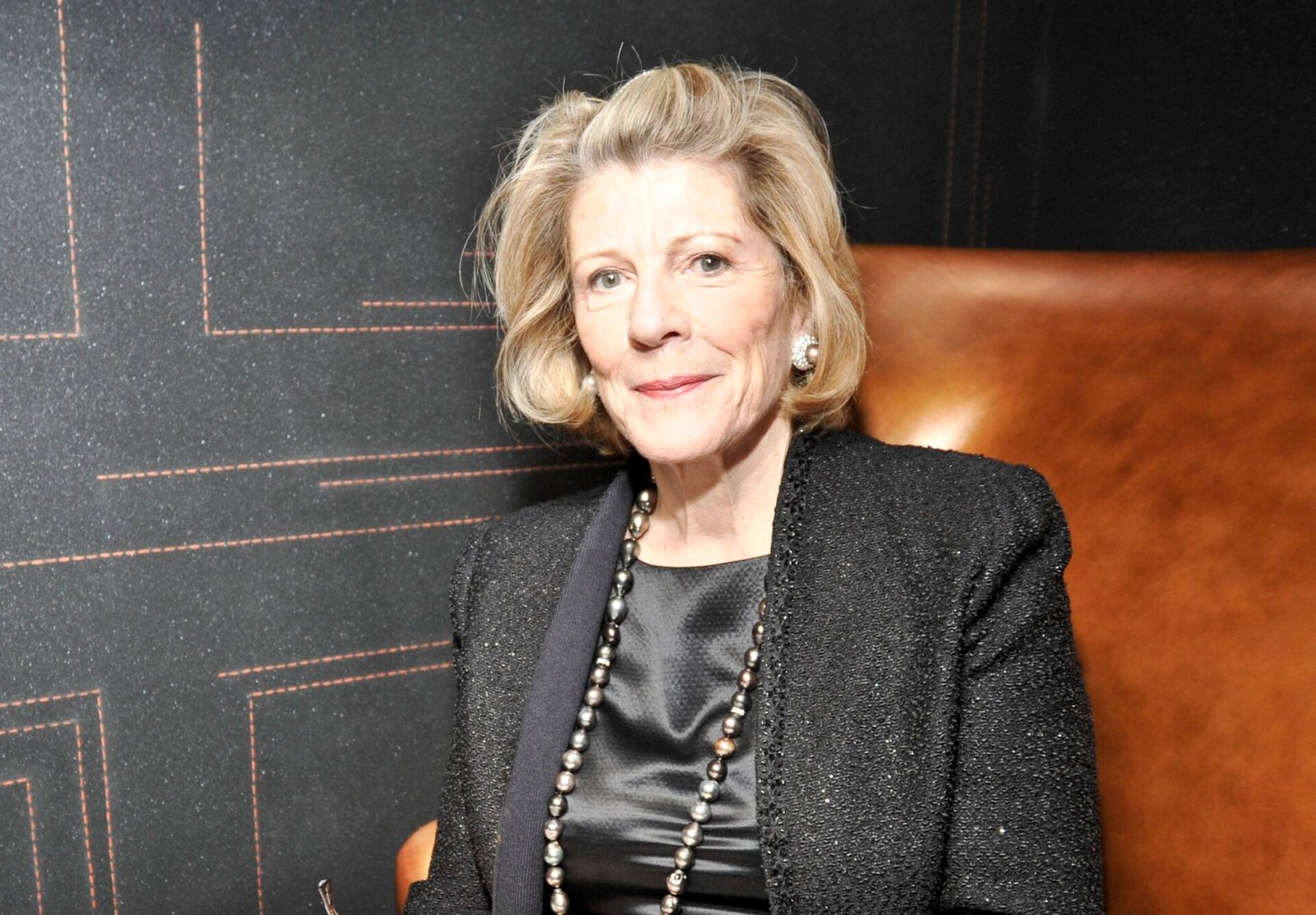
Agnes Gund, the former president of New York’s Museum of Modern Art and leading art collector and philanthropist dedicated to social justice, has died at her Manhattan home, at age 87.
Gund’s daughter, filmmaker Catherine Gund, confirmed her death to the New York Times. The younger Gund directed a 2020 documentary, Aggie, about Gund’s life’s work, and even turned her mother’s art collection into an Apples-to-Apples-style board game.
At MoMA, Gund first joined the museum’s international council in 1967, and then the board of trustees in 1976. She held the board presidency, an unpaid role, from 1991 to 2002. During her tenure, Gund oversaw a $858 million expansion erecting a new building by Yoshio Taniguchi, completed in 2004, and helped forge a merger with the P.S. 1 Center for Contemporary Art in Long Island City, Queens, now known as MoMA PS1. She stayed on as president emerita of the board until her death.
As a collector, Gund was a champion of contemporary art, encouraging MoMA to expand its holdings in that area. She owned work by some of the great American artists of the 20th century, many of whom she counted as friends—Roy Lichtenstein, Mark Rothko, James Rosenquist, Jasper Johns, Claes Oldenburg, Ellsworth Kelly, Brice Marden, and Frank Stella.
But Gund, a self-proclaimed feminist and prominent Democratic donor, was also known for supporting artists of color and women artists. She believed firmly in the power of art to solve problems. “I think that now artists are really going to come to the fore when it comes to political and social causes,” she told then-Artnet News editor-in-chief Andrew Goldstein in 2017. “I think art can make a difference. I think art can help.”

Agnes Gund and Klaus Biesenbach at the 2018 MoMA Party in the Garden at the Museum of Modern Art, New York. Photo: by Paul Bruinooge, ©Patrick McMullan.
Who Was Agnes Gund?
Born in Cleveland on August 13, 1938, Gund, known as Aggie, was the daughter of Jessica Roesler Gund and George Gund II. The family fortune, which Gund inherited upon her father’s death in 1966, came from real estate and brewing.
She was engaged in art from an early age through classes at the Cleveland Museum of Art. (Gund would grow up to be a major supporter of the institution, from donating her first major acquisition, Henry Moore’s sculpture Three-Way Piece No. 2 to the museum in 1970, to the gift of five works by contemporary American artists in 2017, among other artwork.)
After her mother’s death in 1954, Gund enrolled at Miss Porter’s School in Farmington, Connecticut, where, she told Lifestyles Magazine, a “magical art history teacher” named Sarah B. MacLennan taught her how to look at art.

Agnes Gund at the Frick in 2011. Photo: by Amber De Vos, ©Patrick McMullan.
“On the weekends, I’d come into New York with an aunt, and we would go to all the museums in the city. We would go to the Museum of Modern Art and to the Metropolitan Museum of Art. I went to the Frick Collection so many times that I knew where everything was by memory,” Gund told the Gagosian Quarterly. “I sometimes joke that if I ever go to prison, what’s going to keep me from going crazy is that I have these museums memorized, and I can go through them and see all my favorite things in my head.”
Gund got a degree in history from the Connecticut College for Women. Later in life, after her divorce, she went back to school, earning a master’s in art history at the Fogg Museum, at the Harvard Art Museums in Cambridge in 1980.
Twice married and twice divorced, to Albrecht Saalfield and Daniel Shapiro, Gund is survived by her four children, Catherine Gund, David, Anna, and Jessica Saalfield, and 12 grandchildren, as well as her siblings Gordon, Geoffrey, and Louise Gund.

Agnes Gund at a Studio in a School event in 2004.Photo: ©Patrick McMullan.
Gund was also the founder of Studio in a School, which she formed in 1977 in response to cuts to arts education in New York City public schools.
“I just couldn’t believe that they wouldn’t still have an arts and music program at least available,” Gund told me in 2017, on the occasion of the organization’s 40th anniversary. “Our whole idea was to have artists who were the teachers.”
Those teachers include such luminaries as Mark di Suvero, Jeff Koons, Julie Mehretu, and Fred Wilson.
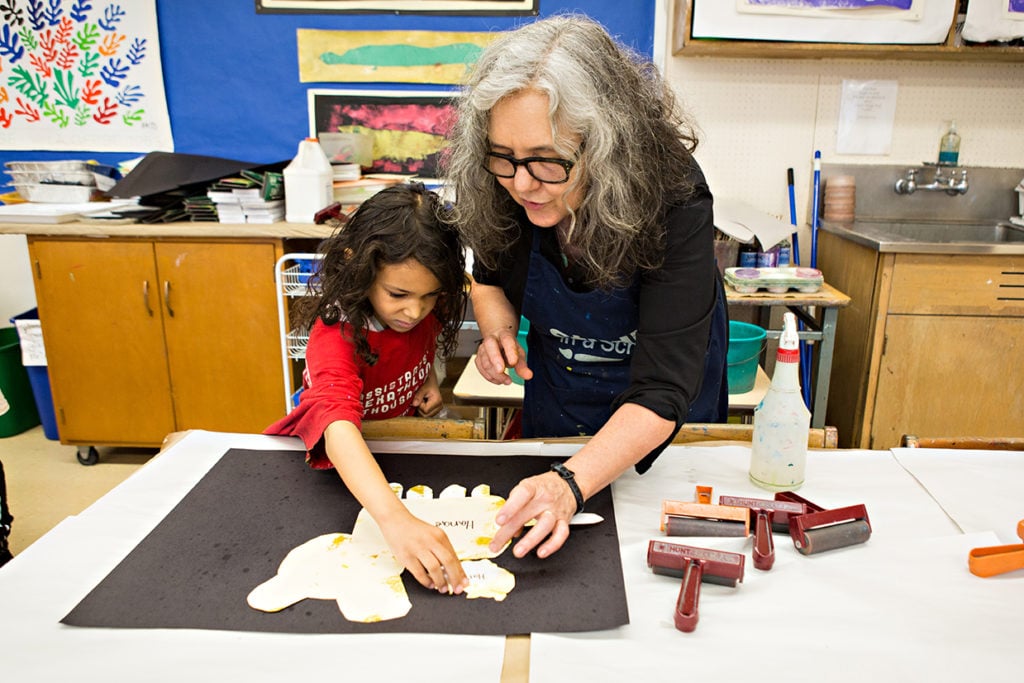
Students working at PS 112 in Manhattan with Cathy Ramey, who has worked with Studio in a School for over 20 years. Photo courtesy of Studio in a School ©Mindy Best.
Collecting and Philanthropy Were Closely Linked
It was rare for Gund to sell works from her collection, and when she did, it was for a good cause. In 2022, she sold Lichtenstein’s Mirror #5 (1970) for $3.18 million, to benefit the work of two nonprofits fighting for reproductive rights after the Supreme Court overturned Roe v. Wade. Her own organization, the Art for Justice Fund, also contributed a matching donation.
Gund had established the five-year fund, which was managed by the Ford Foundation, from the proceeds of another sale of Lichtenstein from her collection, for $150 million in 2017. Dedicated to supporting organizations and individuals working to reform the criminal justice system, it provided millions in grants. The initiative concluded with a 2023 exhibition at the Ford Foundation Gallery in New York featuring work by Titus Kaphar, Faith Ringgold, Jesse Krimes, Sherrill Roland, and the For Freedoms collective, among other artists.
In 2019, she co-chaired with Oprah Winfrey a charity auction for her alma mater Miss Porter’s, titled “By Women, for Tomorrow’s Women.” The sale raised $3.9 million, led by Gund’s donation of Blanco y Verde (1966–67) by Carmen Herrera, which fetched $2.9 million, a record price for the artist.
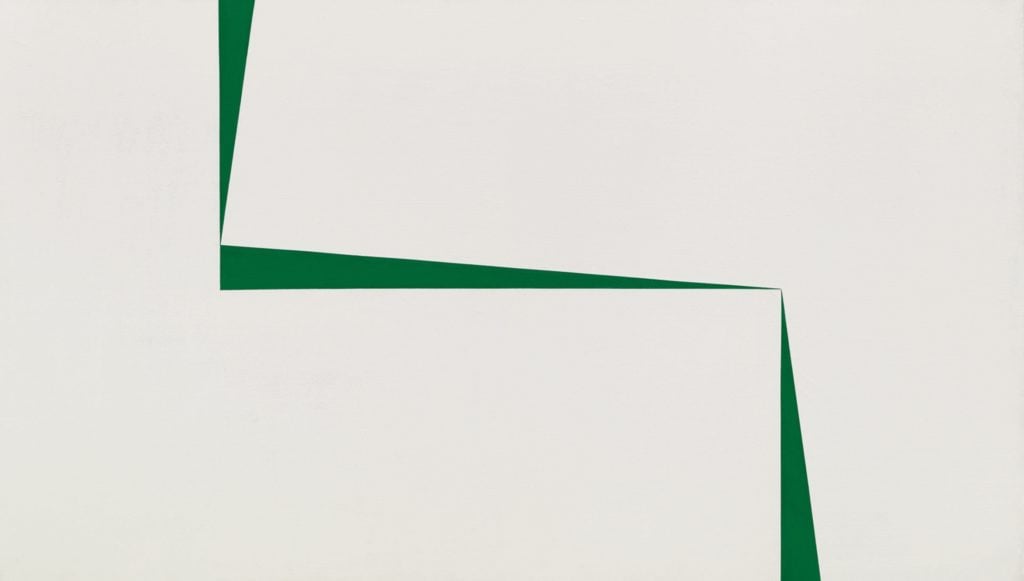
Carmen Herrera, Blanco y Verde (1966–67) sold for $2.9 million at the Miss Porter’s School’s “By Women for Tomorrow’s Women” benefit auction at Sotheby’s New York, a world record for the artist. Courtesy of Sotheby’s New York.
But Gund’s desire to give to good causes could also undermine her ability to purchase the art that she loved. She told the NYT in 2014 that she was prone to giving “more money than I really have”—in a 2009 interview, the Brooklyn Rail noted that Gund would donate two-thirds of her annual income each year.
This urge to give was motivated by “guilt,” Gund admitted in a 2018 NYT piece asking if she was “the Last Good Rich Person?”
The vast majority of Gund’s collection is promised to museums, and she made major gifts during her lifetime to the Philadelphia Museum of Art, as well as the Cleveland Museum and the MoMA, where she donated more than 250 artworks. A 2018 MoMA exhibition, “Studio Visit: Selected Gifts From Agnes Gund,” highlighted this generosity.

“Studio Visit: Selected Gifts From Agnes Gund,” on view at the Museum of Modern Art, New York. Hanging on the partition to the left is Jasper Johns, Between the Clock and the Bed (1981), with smaller works by Willie Cole and Catherine Opie on the back wall. The sculptures, from left, are by Joseph Beuys, Jackie Winsor, and Terry Adkins. Photo: by Denis Doorly, courtesy of the Museum of Modern Art, New York.
President Bill Clinton recognized Gund’s philanthropic work with the National Medal of Arts in 1997.
Gund’s taste in art was famously wide-ranging. When asked what she looked for in art, she told Gagosian, “Everything. That’s my problem. I can’t go look at galleries without ending up wanting to have something. It’s a disease.”
Her 2,000-odd piece collection was known to include Joseph Cornell, Philip Guston, Vija Celmins, Willem de Kooning, Eva Hesse, Lee Bontecou, Lynda Benglis, Kara Walker, Derrick Adams, Marina Abramoviç, Dawoud Bey, Alice Aycock, Romare Bearden, Mark Bradford, Nick Cave, Christo and Jeanne-Claude, Nan Goldin, Arshile Gorky, David Hammons, Robert Indiana, Alex Katz, William Kentridge, Yayoi Kusama, Paul Klee, Kerry James Marshall, Mary Miss, Ana Mendieta, Alice Neel, Shirin Neshat, Martin Puryear, Susan Rothenberg, Richard Serra, Ed Ruscha, Laurie Simmons, Kiki Smith, Carrie Mae Weems, Alma Thomas, LaToya Ruby Frazier, and Lorna Simpson.
Gund was a member of the New York State Council on the Arts and the chairwoman of the Cultural Affairs Advisory Commission of New York City. She was also on the board at the Morgan Library & Museum and the Frick Collection, both in New York, Socrates Sculpture Park in Long Island City, and the Menil Collection in Houston, and on the philanthropy committee of the Robert Rauschenberg Foundation.
[ad_2]
Source link