
[ad_1]
A portrait of a heroic naval chaplain now hangs at the spiritual home of the UK’s military clergy – to inspire those following in his footsteps.
Christopher ‘Kit’ Tanner earned the nation’s highest decoration for bravery for saving the lives of at least 30 shipmates when cruiser HMS Fiji was lost during the Battle of Crete in 1941.
So when naval chaplaincy historians were looking for a ‘bish’ to immortalise on canvas at Beckett House in Wiltshire, they looked to his example.
Beckett House – a 19th Century mock Elizabethan country house – is part of the UK Defence Academy at Shrivenham and replaces Amport House in Hampshire as a place of learning and reflection for chaplains across the three Services.
Its walls are lined with photographs, portraits and paintings of decorated Army and RAF chaplains, priests and padres down the years… but not a man or woman of the cloth from the Royal Navy similarly honoured.
The charity Front-Line Naval Chaplains, which looks to inspire present and future chaplains in the Fleet through the example of their predecessors, were determined to put that right.
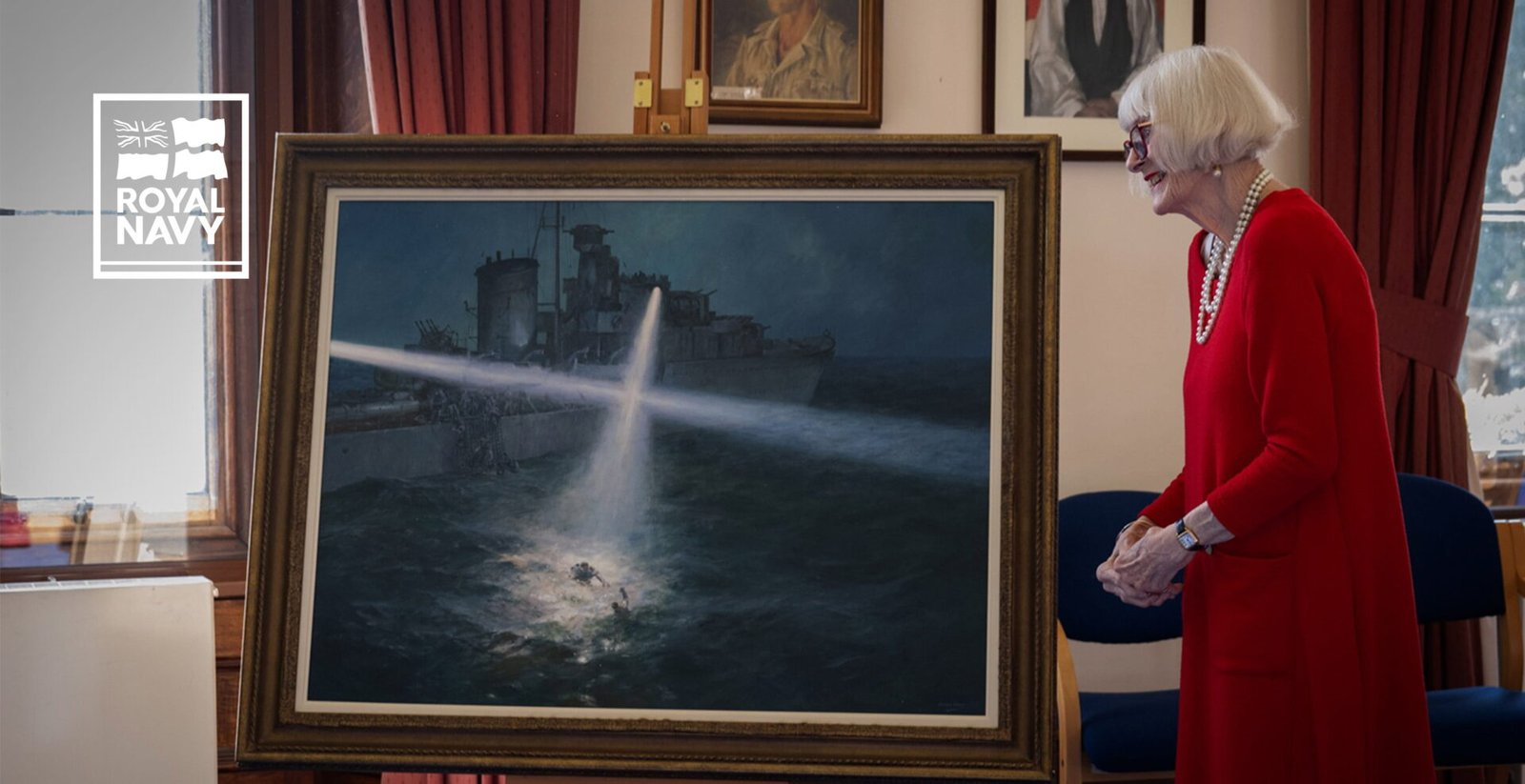
“Everyone is impressed by the painting – it captures his deeds, his bravery, his spiritual side and his sacrifice,” said Linda Parker from Front-Line Naval Chaplains
“There were portraits, paintings and photographs throughout Beckett House but none from the Navy so we decided to rectify that omission.”
Helping to raise £20,000 in co-operation with other charities, it commissioned one of the UK’s most respected maritime artists, Geoff Hunt, and selected Kit Tanner as the inspirational priest.
When war came in 1939, the former England rugby player turned village vicar joined the Naval Reserve as a chaplain.
He was eventually drafted to cruiser Fiji. When the Germans invaded Crete in May 1941, Fiji was part of the large naval force dispatched to prevent reinforcements arriving by sea.
The task force came under relentless air attack – famously depicted by Noel Coward’s In Which We Serve.
On 22 May, some 370 bombs were hurled at HMS Fiji alone by the Luftwaffe. Throughout the attack, Kit Tanner proved an inspiration to his shipmates, visiting all parts of the ship, consoling the men, listening to their fears, reassuring them, delivering drinks and sandwiches at action stations.
Having survived most of the enemy onslaught and with all her flak ammunition fired off, Fiji looked to have escaped – but as the day drew to a close she was hit by two bombs in quick succession.
She sank in under 30 minutes, but there was enough time for Kit Tanner to see to it tall all 60 men being treated in the sickbay were evacuated and able to abandon ship.
In the water awaiting rescue, he encouraged his shipmates never to lose heart – even as rescuing destroyers withdrew – and led them in various songs (hymns, crowd-pleasers like Roll Out The Barrel and boisterous rugby tunes) – until the rescuers returned.
Kit Tanner was picked up by HMS Kandahar in the small hours of 23 May – but with men still in the water, he returned repeatedly to help them. When the last was rescued – most accounts suggest he saved 30 men – he climbed back on board. Shortly afterwards, the chaplain collapsed from exhaustion and died, aged just 32.
It earned him a posthumous Albert Medal, today replaced by the George Cross and as high a gallantry decoration as the Victoria Cross – the only thing absent was enemy fire.
Nearly 85 years later his daughter Angela Allen was guest of honour as the portrait of her father – one year in the making and depicting him helping a shipmate under the beams of Kandahar’s searchlights (which form a symbolic cross) – was unveiled at Shrivenham.
Dr Parker added: “We looked through the history of the chaplaincy and came across Kit Tanner, who is perfect because there’s a lot of material available about him and because he’s both known and unknown.
“His bravery and his Albert Medal were highly publicised in the newspapers of the time, but today he’s largely unknown sadly. I doubt many people in the Navy have heard of him.
“Every time I go through his papers and read his story and the testimonies, he comes across as a wonderful, inspirational individual, and his bravery was quite remarkable.”
[ad_2]
Source link