
[ad_1]
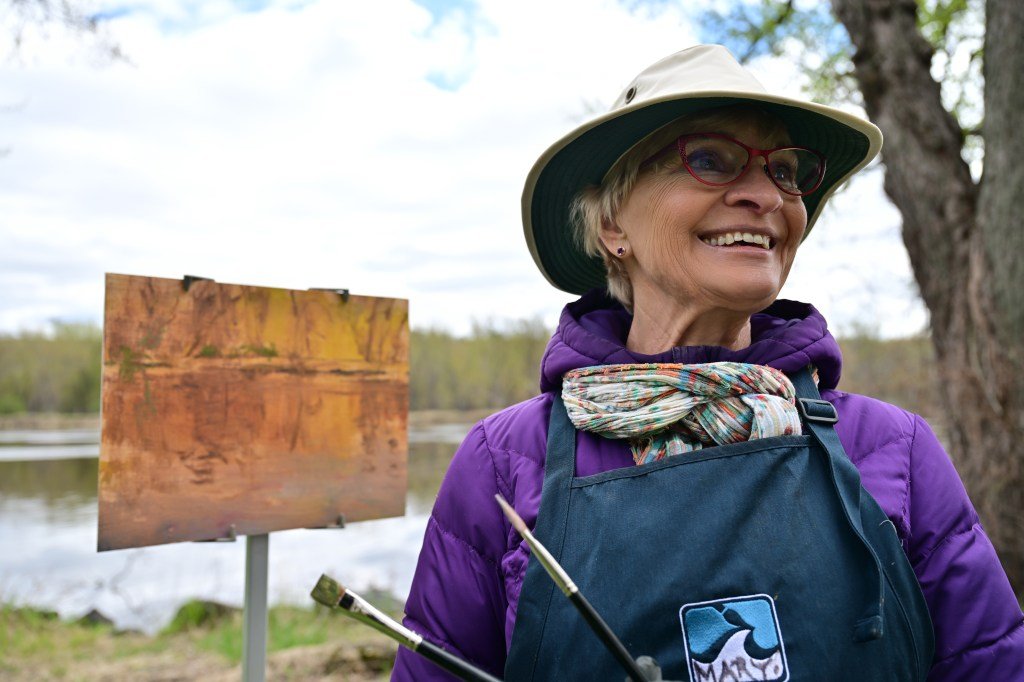
Landscape artist Mary Pettis is walking along the St. Croix River in Interstate State Park just south of Taylors Falls, trying to decide on the subject of her next painting.
“It shouldn’t be half water, half sky,” said Pettis, scanning the Wisconsin shoreline. “Generally speaking, the story should be either the water or the land. So where do you put the horizon line? If I set up here, then what’s going to happen with the light? Can I make a painting out of something that’s so subtle and so dull?”
It turns out she can.

Within two hours of setting up her easel and paints — kept in a “go bag” in the back of her Toyota Highlander, which she calls “Scottie” — Pettis produces a 12-by-16-inch painting filled with light and color that somehow captures the moving water, swaying trees and glistening sunbeams.
Pettis, 72, of Taylors Falls, is one of the nation’s top painters in the en plein air tradition, painting “in the open air.” She was recently named a Top 40 Finalist in the 15th Annual PleinAir Salon Art Competition — chosen from among the year’s monthly award winners, representing hundreds of painters from around the world.

Her painting “Quiet Visitor,” which features Cascade Falls in Osceola, Wis., was named the “Best Plein Air Landscape” in July 2025. It’s now in the running for a $15,000 grand prize and a cover feature in PleinAir Magazine. The winner will be announced May 14 at the PleinAir Convention & Expo in Branson, Mo.
“It is a rare and significant honor,” said Jen Kochevar, her longtime business partner. “It places Mary among the finest painters in the nation.”
The painting, which is done in Pettis’ signature contemporary style of expressive realism, showcases “Mary’s brilliance with a brush,” Kochevar said. “The first time I saw it, I had a deeply moving experience. It viscerally pulled me in towards it and, simultaneously, reached out and touched me. All I knew was that I couldn’t walk away.”
Finding her subject
Pettis checked out several spots along the St. Croix River before unpacking her easel and oil paints near a picnic table just south of the boat ramp.
“I love the moving water here,” she said. “I love the dark bank over there, and I love the sloping trees. There are two sloping trees that kind of have a rhythm to them, and those trees with the grayer trunks, I kind of like those, too. I like how that plays with the bank. So I think this is my spot. Yeah, this is great.”
Pettis said she pictures the painting in her mind before ever putting brush to canvas.
“I think the sky will be an element, but it will be a high horizon,” she said. “We’ll wait for there to be a little squall on the water. … OK, it’s done in my head. I love the rocks here. I may or may not put them in. We’ll see. The painting will tell me what it wants to do. I’m going to move that tree over a little bit because I’m an artist, and I can move mountains! The story that I’m going to tell is looking at the light through the trees. I’ll wait until it happens again. There was light back there, and then all these trees were silhouetted. It was so beautiful. That’s what my story is going to be about.”
One of her favorite times to paint is late morning, she said, “right before the light flips.”
“I like looking into the light with the shadows of the big trees,” she said. “It just seems to be such a wonderful metaphor. Once the light starts getting into afternoon light, then I start looking for a different subject because the light becomes flat. It doesn’t have that mysterious, looking-into-the-shadows thing across the river. I love backlight.”
The St. Croix River, a federally protected riverway, is her favorite subject. She estimates she’s painted it 3,000 to 4,000 times.
“I love its stunning beauty,” Pettis said. “I love the color of the water. The water is colored by the tamarack tree, kind of a root-beer color, which is a beautiful balance to all the greens — and just the metaphorical symbolic significance of it is really profound. I love that it has been preserved for eons, and it will remain like this. No one can build on it or destroy it.”
Pettis poured a few tablespoons of water into two milk-carton caps and then put on a pair of disposable chemical-resistant black gloves — a must ever since doctors found she had arsenic in her blood, she said — before unpacking her paints.
“This is fast-dry titanium white by Gamblin,” she said. “It has alkyd in it, which will help the painting dry faster. It’s wonderful for en plein air painting events. I thought transparent orange might be good depending on how the soft maples are budding out.”
Still more colors come out: cadmium yellow light, Naples yellow, cadmium orange, transparent yellow oxide, alizarin crimson, phthalo green, king’s blue, ultramarine blue and transparent oxide brown. Her favorite is Old Holland bright violet, which is “very potent,” she said. “It’s about 60 bucks a tube.”
Pettis put a half-teaspoon of the vibrant violet color on her palette, and then used the tip of her silver palette knife to capture a spot of color the size of a grain of rice.
“Watch what it’ll do,” she said. “If I mix this with the Cadmium yellow light, I can make my own ochre with the violet. This way I can bend the color toward the violet if I want or toward the yellow over here. If you really want to see what’s happening, then you add just a little bit of white, and look at that. See, it’s not just brown. It’s just, like, beautiful. Nummy.”
‘Living Master’

Pettis’ works have been exhibited in Geneva, Barcelona, New York City and Scottsdale. She has taught painting workshops in the Upper Midwest, Italy, France and Maui. The average price of her paintings is around $7,000.
In 2017, Pettis became only the ninth American woman painter to be named an “ARC Living Master” by the Art Renewal Center — a designation recognizing the world’s finest classical painters.
The designation is for artists who are “creating fully professional works of art, as well as some identifiable masterpieces,” Pettis said. “‘Some identifiable masterpieces,’ I just love that. But that’s kind of where I feel that I am — an occasional masterpiece. Every once in a while, I’ll have one that I think, ‘OK, I deserve (that) title.’”
Pettis, who has three children, two grandchildren and two foster grandchildren, grew up on a farm in Kasota, Minn. “It was a really wonderful upbringing, and I’m sure that it informed my work ethic,” she said. “You can be really inspired and really talented, but not get anywhere if you’re not willing to do the work.”
Pettis said she decided to be an artist while attending the College of St. Benedict in St. Joseph, Minn., where she studied painting, music and drama, she said.
“I was in ‘Macbeth’ my freshman year,” she said. “At the same time, I was taking a painting class and painting a still-life of my grandfather’s things. They were his hunting things. He had just passed away, and it was his cap and a decoy and a number of gun shells and his scarf and the duck box. It was very complicated, and I lost myself in the work. I would paint till 4 o’clock in the morning. It just kept looking more and more real.
“At the end of the play, all I had to show for it was the program, but after the painting class, I had a beautiful and captivating memorial to my grandpa,” she said. “I thought, ‘I’m going to be a painter.’ I never questioned whether or not I could do it. I’m just so stubborn and dogged, and I figured if I keep my heart in the right place and keep trying to relay the experiences that I’m having through paint, through this medium, through this language, that if there’s room for me at the top, then that’ll be great. That’ll be frosting on the cake.”
Pettis was a student of Hungarian painter Bela Petheo at St. John’s University, Richard Lack at Atelier Lack in Minneapolis and Daniel Graves, who founded The Florence Academy of Art. In the 1990s, artist Jim Wilcox introduced her to the “wet-in-wet” en plein air approach, and she moved her studio outdoors, she said.
Pettis and her husband, Randy Pearson, start nearly every day with a swim in the St. Croix River, as soon as its temperature hits 60 degrees, generally May through October. During the winter, the two cross-country ski and hike with Boom, their golden retriever.
“I go outside when I need to refill my soul,” she said. “I usually don’t think while I’m painting outside. I just respond.”
Learning and teaching
Pettis works outdoors in all types of weather. “Generations,” a finalist in the American Impressionist Society’s 22nd Annual National Juried Exhibition, was painted en plein air in her backyard when it was “23 degrees, not counting the wind chill,” she said.

She pushes herself to learn something every time she goes out to paint and regularly tests herself with different challenges like using a different kind of blue, limiting her palette to just a few colors, expanding her palette to more than a dozen colors, or giving herself a time limit, she said.
“It’s just like learning new words,” she said. “What is it that I particularly like this particular time of day, this particular day? Maybe I’m trying to unlock the mystery of moving water or changing clouds. How do you help people hear the spring peepers or sandhill cranes, even though they’re not in the painting?”
When she isn’t painting outside, Pettis works out of a studio next door to her house in Taylors Falls. It’s lined with dozens of her paintings. Classical music from Minnesota Public Radio streams from her computer. A small message — written in pencil on one of the wooden arms of her easel — reads: “Let me do my best with my simple gift.”
“Nature is telling me how it wants to be painted,” said Pettis, who occasionally teaches art workshops around the country. “What that means, as an expressive realist, is that as the feeling comes to me, I put it down unedited. I just don’t think about it. I’m painting intuitively right now. I spent a lot of years plodding along and thinking and doing, but that was to learn the language. Once you learn the language, it’s like (John) Ruskin said: ‘What good is it to be a great orator if you have nothing of import to say?’ It’s more important to have something to say.”
Award-winning artist Kami Mendlik, who grew up in Marine on St. Croix, said she had to persuade Pettis to take her on as a student in the early 1990s.
“She was really busy and occupied, and she didn’t seem to have a lot of time,” said Mendlik, who lives in Grant. “I basically just kept knocking at her door. I remember asking her, ‘How do you paint a tree?’ She said, ‘Well, go paint 100 trees and then come back and ask me that.’ So I did, and then I brought my 100 paintings of trees back, knocked on her door and said, ‘OK, so I still have a question.’ She was like, ‘OK, come in. I’m going to pass this on to you, but you have to pass it on.’”
“Mary was the first person that really believed that I could do this, and I needed that then,” she said. “It was just like a belief system, like ‘You can do this.’ The power of believing.”
Pettis said she used to spend weeks, even months, making sure all the details of a painting were perfect. “It took forever to get fast,” she said. “It took miles and miles and miles of canvas.”
Now, after five decades of painting, Pettis said she has reached the point where she is “grabbing the essence of what (she is) feeling and then figuring out which tools are going to be the most appropriate,” she said.
“It’s like making music or writing poetry rather than long, thick novels,” she said. “What kind of color scheme, what kind of values, what kind of composition and what kind of brush work will help somebody else feel something when they look at that painting — not just recognize it as a subject or a particular motif, but how do we get them to feel something? How do I express it in a manner in which it touches somebody’s heart and not just their mind?”
‘Never the same’

As she worked on her painting of the St. Croix River the other morning, Pettis said she has no plans to slow down or retire.
“This is what it’s about,” she said. “It’s about communing with nature and being drawn into it. It’s never, never the same. It’s affected by what’s happening in places that we can’t see. Just like life, everything affects everything else. If it rains in the northern part of the watershed, up in the Namekagon, then it affects it down here. It’s all connected.
“Look at that swirl,” she said. “That’s a cute little swirl, but I can’t have that because if I had a sweep like that, that would not be the feeling that I’m after. That’s too dynamic and moves too fast. The movement that I want is slower, so I have to pick and choose those elements that will reflect the calmness and serenity and the subtlety and the harmony.”
Pettis took out a paper towel and began rubbing the paints together on the easel. “While I do this, I’m sensing what the story is going to be about for me,” she said. “Already I’m feeling the movement of the water and just this pull. I like to push the color first, and then back up on it as much as is necessary to tell the story or to make a good painting. I’m going to just try to get the feeling of it first.”
Pettis then added a dab of green to the canvas. “There’s not going to be a lot of green,” she said. “Just a whisper. And then I’ll just build them up slowly.”
She took a step back to appraise her work.
“All of a sudden, it’s looking back at me,” she said. “I love that. That’s wonderful. It’s like, ‘Hello.’ I can’t wait. If the sun pops out, which it’s going to, it’s going to pop in and out, it’ll be really interesting. I can show that that’s happening in the water. I’m going to keep this one loose and fresh.”
She named it “Waking Spring.”
“I’ve been doing this forever, and it’s just been such a privilege and an honor,” Pettis said. “It’s not a bad gig to be looking for beauty in the world as your main vocation and avocation, that’s for sure. My motivation is just the beauty of the world. Nature is so giving, and it’s so hard to take the time to listen to her. But when we’re out on location, nature just keeps unveiling her secrets. As you sit there, you have time for all the layers to dissolve, and you go in the zone. It’s a meditation, and after doing it for 50 years, I feel like I finally speak the language.”
Mary Pettis artwork
Mary Pettis showcases her available works in her gallery, Gallery 366, located within the Northrup King Building in Minneapolis.
For more information, go to marypettis.com.
[ad_2]
Source link