
[ad_1]
One of the warmest days of the year so far has brought about an awakening. The warmth of the sun, sporadically shielded by clouds shuffling around a brilliant blue sky, has brought bird life back into play.
Magpies, crows, black birds a robin and wren stake their place on branches and shed roofs to watch the plotters within who, for the next few months, will be toiling on their patches and turning the earth encouraging new life and growth in a patient process which, ordinarily, results in produce on their plates.
The substantial spread of beds are part of a historic allotment. Cottingley Bridge Allotment Gardens, near Bingley, dates back some 175 years.


It was in the Autumn of 2017 that Alice Fox took over Plot 105. Broad beans, potatoes and sprouting broccoli are among the good things growing within the 45m long by 12m wide patch of land where fruit trees and bushes also ensure a plentiful supply of apples, peaches and soft fruits including gooseberries and raspberries.
For Fox, Plot 105 is a very productive plot – not least for nourishment. As an artist it provides Alice with a niche – a place where weeds are welcome and tamed to become mediums for her work.
Carrying a trug of potted plants, Fox winds her way down the grass path to one of two sheds next to which sits a greenhouse where a peach tree is just finishing blossoming. Here she can while away the hours planting, gathering and preparing in this unique grow your own artistic process.
“I have always been into gardening but I never had a decent sized garden.”

Before taking on the plot, Fox made do with the tiny growing space she created at the family home in nearby Saltaire. Her interest in growing her own began while studying for her BA in Textiles at Bradford College.
“I became more interested in growing my own materials – things like linen, all from plants, but if you want to buy these materials I found it impossible to find out where they have been grown,” she says.
“In order to make a sustainable informed choice about materials you cannot find out where they have been grown, I got more interested in growing my own.”
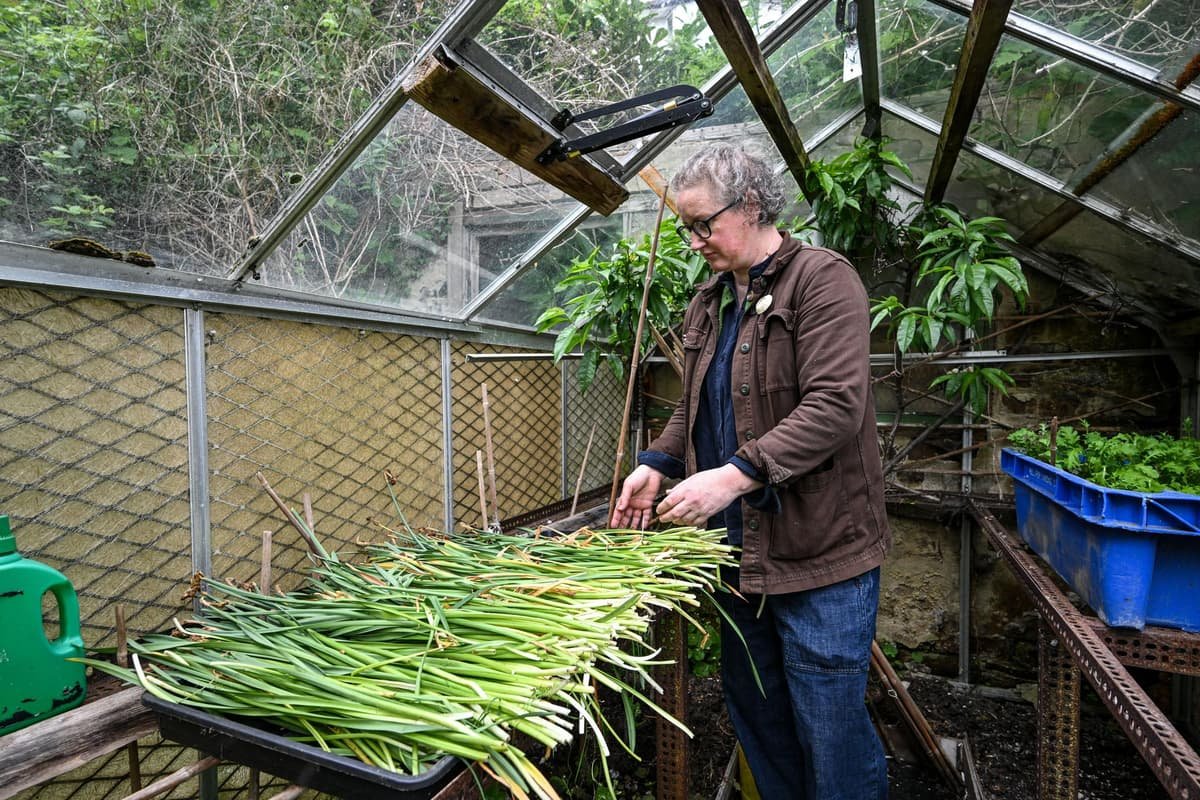
Collecting a bunch of flax stems from the work bench, Fox explains the process of transforming the whispy strands, once daintily decorated with purple flowers, into wall mounted art works showcased in exhibitions and adorning art galleries in London.

This workable fibre grows about 1m high. “I will be sewing it mid-April and it will be 100 days until it gets pulled up,” she explains. Once the whole plant has been pulled up the process of extracting the fibre within the stems – known as linen – begins.
“It can be done commercially with machines but I am doing it on a tiny scale. I am growing three square metres but there is a whole lot of processing to go through to get to that spun fibre.”
Once the plant is pulled it is dried then the retting begins. “I put it out on the grass for a couple of weeks and the dew and the rain starts to break down the pectin.”
This process of controlled rotting encourages bacteria to weaken the structure. Once dried, Alice uses a hand worked machine to turn the fibres into linen (line fibres) which she uses in various ways in her work.

Nettles and daffodil leaves are other home grown mediums featured in Alice’s eye-catching art works which include decorative wall art; cards and postcards and sculptural basketry.
“You can strip nettle and use it in different ways. Flax is what I am growing from seed but all the other fibres I use are things that are growing here anyway,” says Fox.
Taking a small basketry weaved bowl from the work bench, she explains its formation from bindweed. A beautifully weaved pouch-like object was formed from a daffodil leaf.
Brambles also produce a fibre for Fox’s work. “I can strip bramble and there is a fibre within the stems and you can use the fibre in a similar way,” she says.
“I am making use of stuff that is growing here anyway amongst the crops. Although the allotment is the focus for the material it is not all cultivated it is this mix. I was thinking how can I use my own material? I knew you could grow Flax in this country and I went on a course to learn how to process the Flax that was on the allotment, but I knew some of the other material I could use. It has been a big journey of discovery.”
Participating in projects – she was a resident artist at Spurn Point in 2012, the national nature reserve peninsula between the North Sea and the Humber Estuary following working as an Otters and Rivers Project Officer for the Yorkshire Wildlife Trust which manages this special site, and held her first solo show in Cornwall in 2015 – has introduced Fox to a wider audience.
Originally from Grimsby, she believes her first degree in Physical Geography (she also has an MA in Creative Practice) instilled an interest in environmental issues and landscapes which are relevant to her work, not only as a full-time artist, but as a writer and teacher.
Making is another essential element she has practiced since childhood. “I was always making stuff as a child and doing a textile degree you do knitting, weaving and embroidery. I have done a lot of stitch-based work and some printing. I have explored a lot of different processes such as basketry,” she explains.
Much of her work stems from traditional techniques. In the past functional items such as bags and string were fashioned from bramble and nettle.
“Dandelion stems aren’t something that have been traditionally used but I have made some big art works with them – it is a really interesting material.
“I want to make my art practice as sustainable as I can. Also, people think that allotments are all about self-sufficiency and food – the approach to growing your own I wanted to apply that to my practice – I want to know exactly where all my materials have come from and I want as small a footprint as possible.”
Taking on the allotment Fox says enabled her to push the boundaries by experimenting with what plants would work for her artwork.
One of her largest wall arts features 2,000 woven dandelion stems and took around a month to make.
Bins brimming with pruned twigs from her apple trees are among the plants from the plot Alice uses to produce dye for her work.
She explains tannin, a natural component of wood, can vary in colour but cooking it down, after chopping and soaking it, intensifies the colour. Adding iron, a traditional dye ingredient, achieves a darker effect.
Within the pages of Plot 105, one of many books Fox has penned to document her impressive range of large and small scale plot productions, some pages are dedicated to charts of colours she has achieved through her natural dyeing process.
Working with the flora naturally growing on her plot, Alice is demonstrating to great effect what can be achieved.
“I think there is something really lovely about celebrating the plants that a lot of people dismiss as something to battle against. I don’t want them growing in certain places, but I also understand how I can use them and have a different relationship with them as a result.”
Alice also hopes her work will encourage people to engage more with nature. “It is making people look at the world around them in a slightly different way.”
Visit www.alicefox.co.uk or search alicefoxartist on Instagram.
[ad_2]
Source link