
[ad_1]
Invisible laser landmarks. AI-generated claims over asteroids. Scaffolding wired into screens and computing systems. At Art Dubai 2026, digital art is no longer confined to NFTs or immersive spectacles. Instead, artists are using technology to question ownership, extraction, memory and humanity’s relationship with the systems it increasingly depends on.
Digital works appear throughout the fair alongside oil paintings, sculptures, and installations, reflecting how deeply artificial intelligence, gaming engines, virtual reality and data systems have become embedded in contemporary practice. For many creatives showing this year, the question is no longer whether digital art belongs in the art world, but how it can reshape the way audiences think about value, ecology and the future.
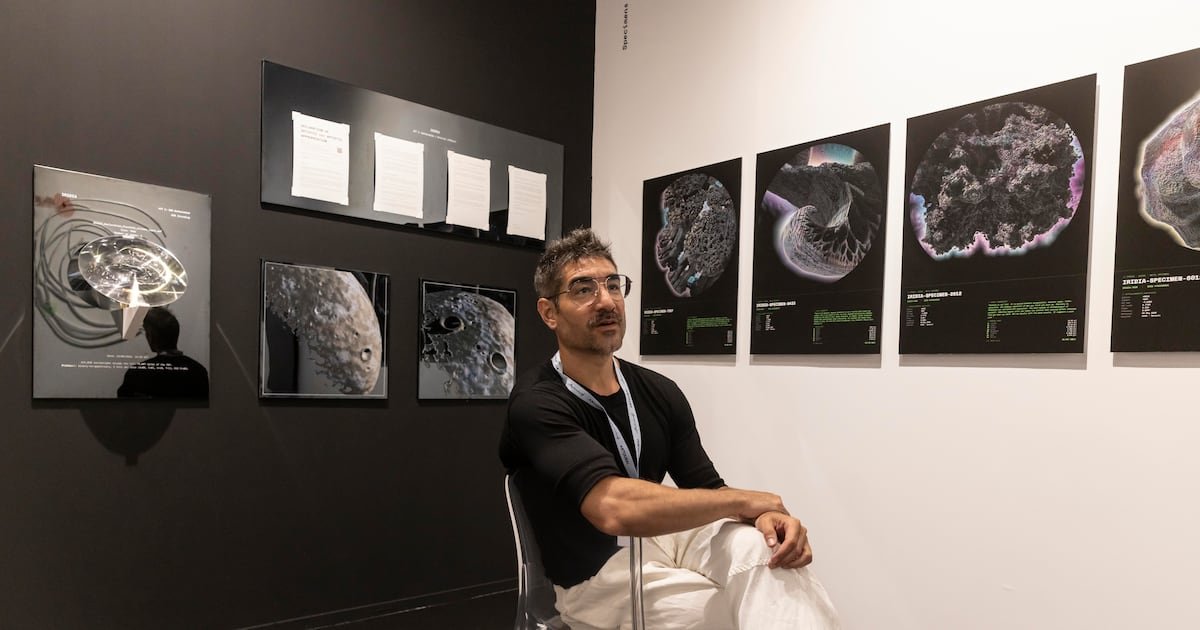
At the booth of Abu Dhabi gallery Rizq Art Initiative, Spanish conceptual artist Soliman Lopez presents Iridia, a sprawling project centred on the asteroid 16 Psyche, a metal-rich celestial body estimated to contain more wealth than the global economy combined. The project includes AI-generated imagery, radio transmissions, synthetic DNA storage and conceptual ownership claims over the asteroid itself.
Lopez describes the work as a response to a world increasingly shaped by extractivism and resource conflict. “If wealth means controlling resources, what does that say about us?” he asks.
The project uses the language of blockchain, AI and data systems to challenge humanity’s instinct to exploit new frontiers, even beyond Earth. One component involves a notarised Declaration of Artistic Appropriation claiming ownership of the asteroid as a cultural object. Another uses Nasa data to generate more than 100,000 AI-created images of Psyche years before the agency’s spacecraft is expected to arrive in 2029.
Speaking at the fair, Lopez said the project was also aimed at raising public awareness. “We need to know what’s going on,” he says. “We can’t wait until big companies or technology leaders take us to the next phase.”
He argues that artists now have a responsibility to help audiences understand technological change before it arrives fully formed into everyday life. “I think art is a beautiful bridge for bringing those questions to people,” he says.
Elsewhere at the fair, Dom Art Projects is making its Art Dubai debut with a presentation that explores how digital technologies can coexist with traditional artistic forms rather than replace them.
The booth brings together works by Sofya Skidan, Michiko Tsuda and Kirill Makarov, each approaching digital art from a different perspective. The presentation suggests that digital reality is simply “another technological medium” that can amplify and redefine artistic expression rather than erase its authenticity.
Skidan’s work imagines hybrid landscapes shaped by climate collapse and ecological transformation, where desert dunes merge with Arctic ice and AI-generated terrains. Her installations combine video, sculpture, digital collage and NFTs, though curator Alisa Bagdonaite resists reducing the work to technological novelty alone.
“She says this is our environment now,” Bagdonaite explains while discussing Skidan’s sculptures made from artificial flowers, plastic and silica. “We need to accept it. We need to understand we are part of nature and nature is part of us.”
For Bagdonaite, digital art is not separate from contemporary art but part of an evolving artistic language that now stretches across screens, installations, virtual spaces and physical objects simultaneously.
That philosophy also extends to the gallery’s presentation of Japanese video artist Tsuda, whose decade-old camera-based works are now being framed almost as historical artefacts in the age of smartphones and AI tools.
Meanwhile, Makarov combines classical oil painting with VR environments and game engines. One of his paintings depicts two women on a balcony in Mexico, but its layered composition reflects the fragmented visual language of modern digital life.
“Painting is not his major media,” Bagdonaite says. “He also works with AI and AR and VR and video games.”
Yet despite the rise of immersive technologies, many artists at Art Dubai are still returning to physical forms and tactile experiences. That tension between digital and material worlds appears repeatedly throughout the event.
At the booth of Foundry, co-founder and artistic director Giuseppe Moscatello and artist Sasha Sime present an installation built from scaffolding, screens, sand and computing systems. Golden metal structures surround suspended monitors while data flows across screens embedded within the work itself.
The installation resembles both industrial architecture and a dystopian parliament chamber where decision-making has been handed over to machines.
Sime says the work emerged from a fascination with “exposed infrastructure” and the hidden mechanics behind cloud computing and AI systems. “We still need Earth to create this,” he says, referring to the minerals and materials required to build digital technologies. “It’s still not 100 per cent in the cloud.”
Like Lopez, Sime sees AI less as a replacement for artists and more as a collaborator. “For me, it’s an easy tool and a third companion to work with now,” he says.
That collaborative attitude reflects a broader shift across the art world. Only a few years ago, digital art at major fairs was often discussed through the speculative rise and collapse of NFTs. Now, conversations have moved towards questions of storytelling, institutional value and artistic process.
Bagdonaite acknowledges that the NFT market had become flooded with weak works that lacked artistic substance, but argues the underlying technologies still have value. “If you want something to stay, you need to buy art,” she says.
Still, she believes digital artists will continue gaining importance through museums and immersive exhibitions. “It’s probably more effective for storytelling,” she says. “It’s more immersive.”
[ad_2]
Source link