
[ad_1]
Canvas to Clay: Georgia O’Keeffe & Maria Martinez to Mata Ortiz & Tonalá is a deceptively quiet exhibition, occupying the Steves Gallery at the San Antonio Museum of Art (SAMA). The show is anchored by an ensemble of paintings and pottery by celebrated artists Georgia O’Keeffe and Maria Martinez. Both were superstars in their respective fields, both were the same age, both narrowly missed surviving to their own centenaries, and both were inextricably connected with the Southwest. But while Martinez and O’Keeffe have frequently been paired together in exhibitions, here SAMA harnesses its location in San Antonio to extend the visual discourse much further south than is typical, placing their work in dialogue with Mexican pottery from Chihuahua and Jalisco.

In this exhibition, four paintings by O’Keeffe hint at the heartfelt affection she had for the Southwest. O’Keeffe is stylistically known for zooming in on a subject and using irregular cropping to highlight the abstract qualities of the natural world. She could famously do this with a few square inches of flower, but she could achieve the same playfully disorienting effect with a panoramic landscape. It was Yellow and Pink II presents an aerial view of a hilly swath of earth bisected by a river, as seen from an airplane. But the river and its tributaries, at first glance, could forgivably be mistaken for limbs of a tree, or even the folds of the petals of some flower of indeterminate species. The subjects of O’Keeffe’s paintings sometimes reveal themselves slowly. “To see takes time,” O’Keeffe wrote, and her paintings encourage and reward slow looking.


Here, O’Keeffe’s paintings, each situated in the Southwest, are paired in dialogue with an ensemble of pottery by New Mexico’s Maria Martinez and her husband Julian, who painted them. Together, wife and husband tirelessly experimented with methods of creating their now-famous black on black pottery, firing their wares by wood and sometimes even animal manure to achieve their intended artistic aims. Julian painted them with highly stylized abstract designs, often sourced from nature, with a crisp refinement and precision. Their Double Spouted Wedding Vessel With Butterflies is particularly arresting, with its dual spouts ascending upward from the same base and its abstracted butterfly pattern, which echoes some of O’Keeffe’s abstractions.
Just as Maria and Julian Martinez revived and innovated upon Indigenous pottery techniques, in the town of Mata Ortiz, 20th century ceramicists similarly revived Indigenous traditions. This is in large part because of the tireless work of the self-taught Juan Quezada, who collected and studied shards of prehistoric pottery from the area, and who over the course of his lifetime gradually reverse-engineered Indigenous pottery making techniques, and along the way helped transform Mata Ortiz, veritably a ghost town, into a thriving center of ceramic production.

The trio of earthenware pots here on display speak to the high level of refinement and craftsmanship that still comes out of Mata Ortiz. Pot with Lid by Hector Gallegos is painted with a dizzying network of checks and chevron patterns applied with a geometric precision that leaves one mystified at how such precise linework could possibly be the product of the unaided human hand (as do the other jars in the ensemble, for that matter). Jars like these, balancing precision and play, are every bit the visual equivalent of the joyous and mathematically precise cello suites of musical mastermind Johan Sebastian Bach.
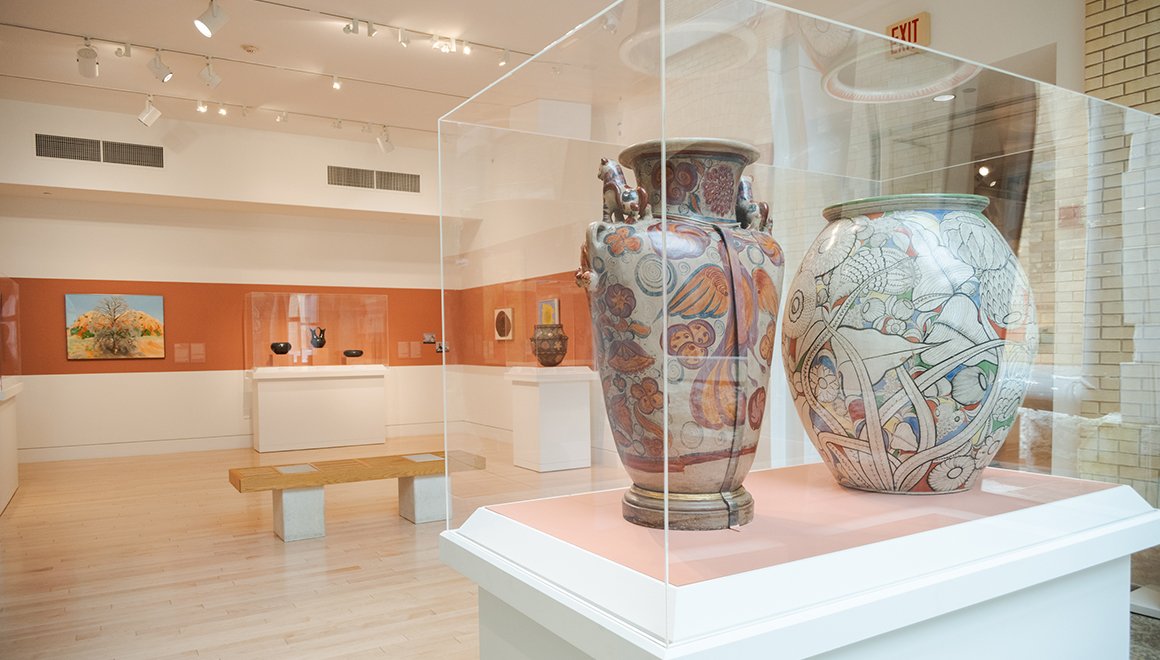
A third and final set of pottery from Tonalá, Jalisco, completes this visual dialogue. This trio of large decorative jars bristle with busy organic and floral forms equally elegant yet quite distinct from the geometric wizardry we see on the jars from Mata Ortiz. A jar covered by an array of precisely painted flowers makes for an eye-catching parallel to O’Keeffe’s Sunflower, New Mexico I. Prized for its clay, vessels from Tonalá famously gave their water an appealing fragrance, and Tonalá pottery was highly prized in Europe. The signage in the gallery even informs us that in Diego Velázquez’s famous painting Las Meninas, the Princess Margarita is being handed a Tonalá jar, testament to its global renown.

A satisfying visual anchor to the exhibition is the imposingly large earthenware jars from Tonalá, one from the 18th century and one from the 20th, each lavishly decorated with painted flowers along the entirety of their exteriors, and both tactfully positioned in front of the gallery’s floor-to-ceiling windows that majestically frame the pair against the imposing Urrutia Arch in SAMA’s courtyard. The considered placement affectionately speaks to a sense of both place and to cultural exchange.
Perhaps the intimate scale of this micro-exhibition belies the layers of history it displays. The didactic wall text refrains from spoon-feeding viewers the throughlines between this varied ensemble of painting and pottery. But the presentation rewards viewers who take their time with it, adhering to O’Keefe’s adage to see slowly. For that matter, the works on view also champion what you might call “slow making.” The Mata Ortiz ceramicists certainly aren’t cutting corners given their fastidiously painted pottery. And in the furiously fast-paced age of mass-production, social media, TikTok, and artificial intelligence, this little show is a welcome respite from the interminable fury of mechanized living and the instant gratification of the now.
Canvas to Clay: Georgia O’Keeffe & Maria Martinez to Mata Ortiz & Tonalá is on view at the San Antonio Museum of Art through October 4, 2026.
[ad_2]
Source link