
[ad_1]

Listen to this article
Estimated 5 minutes
The audio version of this article is generated by AI-based technology. Mispronunciations can occur. We are working with our partners to continually review and improve the results.
Inspiration can come from anywhere. Even a simple household object can become the catalyst for powerful social commentary.
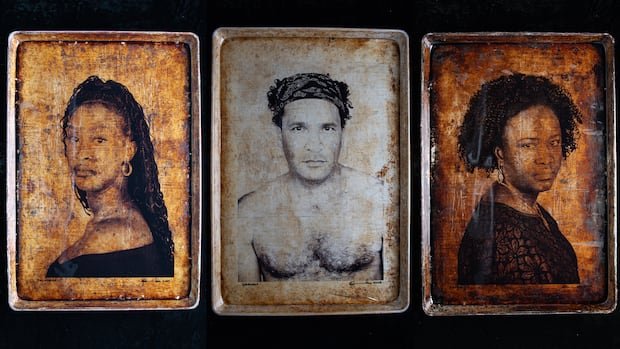
Fredericton-based photographer Gary Weekes uses baking trays to create a modern riff on the tintype. The artist’s unconventional approach opens up discussions around skin colour, history and some of the traumas people of the African diaspora have survived. While the exploration of race has been an undercurrent in his artistic practice, this latest exhibition, Trayces at the University of New Brunswick Art Centre, puts melanin and Blackness in focus.

Weekes, who’s also a personal support worker, was working alongside someone at a bakery, where he saw industrial baking trays going in and out of the oven, getting darker with each use. “I was just looking at these sheets,” Weekes says “and they started to speak to me about how they can be used to add to my photographic practice.” The tone and patina of the trays reminded the artist of black skin.
It took Weekes nearly a year to summon up the courage to ask if he could take some baking trays home. The store allowed him to take 14 of them. He wasn’t sure what he would make with them — until the UNB Art Centre approached him about an exhibition.
Working as an artist-in-residence at the university, Weekes photographed his subjects in a makeshift tent with lights that illuminated them from all sides. He left a slit in the tent wall to fit his camera lens, so the subjects would not see his face. Instead, they would only listen to his voice for directions. Weekes photographed seven men and six women. To create a sense of vulnerability, the men were photographed shirtless and the women were asked to wear a black off-the-shoulder top.

Artist Chris Thomas, one of Weekes’s subjects, says the photographer’s method was effective. “I don’t really show a lot of emotion, so it was pretty cool to see the way they turned out.” An image of the artist’s emotive face became the exhibition flyer, shared widely on social media.
After photographing the subjects, Weekes printed the photos on clear vinyl. He made the darkest parts of the images — such as facial hair, eyes and lips — opaque, and used the patina of each tray to represent the melanin of its subject. He compared photos of each subject to the trays to find the closest hues. The vinyl was then sealed with epoxy resin, giving a beautiful sheen to the “skin” surface. The subjects comprised all ages and included people from Barbados, Guyana, Jamaica, Nigeria and Ghana as well as multi-generational Black New Brunswickers.

Gary Weekes’s new exhibit at the UNB art gallery in Fredericton is a display of portraits on used baking trays. Weekes uses the trays to show the diversity of skin tones and history within New Brunswick’s Black community.
UNB Art Centre exhibition coordinator Lori Quick, who curated Trayces, says the speed at which the show came together felt serendipitous. “I approached him [in] November. For an artist, that’s a tight timeline. I asked him to have an image and materials ready by December for promotion. He sent me the proposal, and it flowed so perfectly.”
“I could not wait to see this work in person,” she continues. “It is sculptural. It’s two dimensional and three dimensional. With the subject matter and the presentation, it all felt like it lined up.”
Before installation in January, the curator had only seen Thomas’s portrait. But once the artworks finally arrived, she was amazed by the combination of material and human story, she says.

For Weekes, every element of the trays felt purposeful. The scratches, for example, evoked scarification, he says. “These techniques are used in Western Africa. They are there to show beauty, show tribal allegiances, geographical locations and mark a coming of age.”
Even the repetitive abuse the trays had suffered — the marks and scrapes — reminded Weekes of the violence committed against Black people in the American South.
“I couldn’t be true to myself without telling the full and most complete story that I could — that these trays revealed to me,” says Weekes. “There were times when I felt that maybe I was going too far with the references to the South — the lynching, the burning of individuals in these fire pits that the locals called ‘n—-r barbecues’ — but when I would try to not include that narrative, it felt like I was not giving the work the justice and the full story that it deserved.”
Despite this difficult subject matter, Weekes hopes visitors to the exhibit understand that Black people across the diaspora are strong and powerful people. “The atrocities that they’ve gone through — that they’ve survived — are not who they are,” he says.
“Although this has happened, which is evident from the trays, we are still strong and we’re still here.”
The Gary Weekes exhibition Trayces runs through March 27 at the University of New Brunswick Art Centre in Fredericton.
[ad_2]
Source link