

[ad_1]
When the most powerful collector in the world gets behind a hot young artist, art history can get made.
This is what happened in 1623, when the newly elected Pope Urban VIII summoned the 25-year-old sculptor Gian Lorenzo Bernini. “It is a great fortune for you, O Cavaliere, to see Cardinal Maffeo Barberini made pope,” he told him, “but it is an even greater fortune for us to have Cavalier Bernini living in our pontificate.”
The episode is recounted in “Bernini e i Barberini,” a fascinating exhibition at the Gallerie Nazionali di Arte Antica at the Palazzo Barberini in Rome that explores one of the most fruitful relationships to ever develop between an artist and his patron.
For the ensuing two decades, Bernini (1598–1680) would have a spectacular career in the service of Urban, expanding his practice to architecture and urban design. After the pontiff’s death, he continued creating Baroque masterpieces for other 17th-century popes, changing the face of Rome.
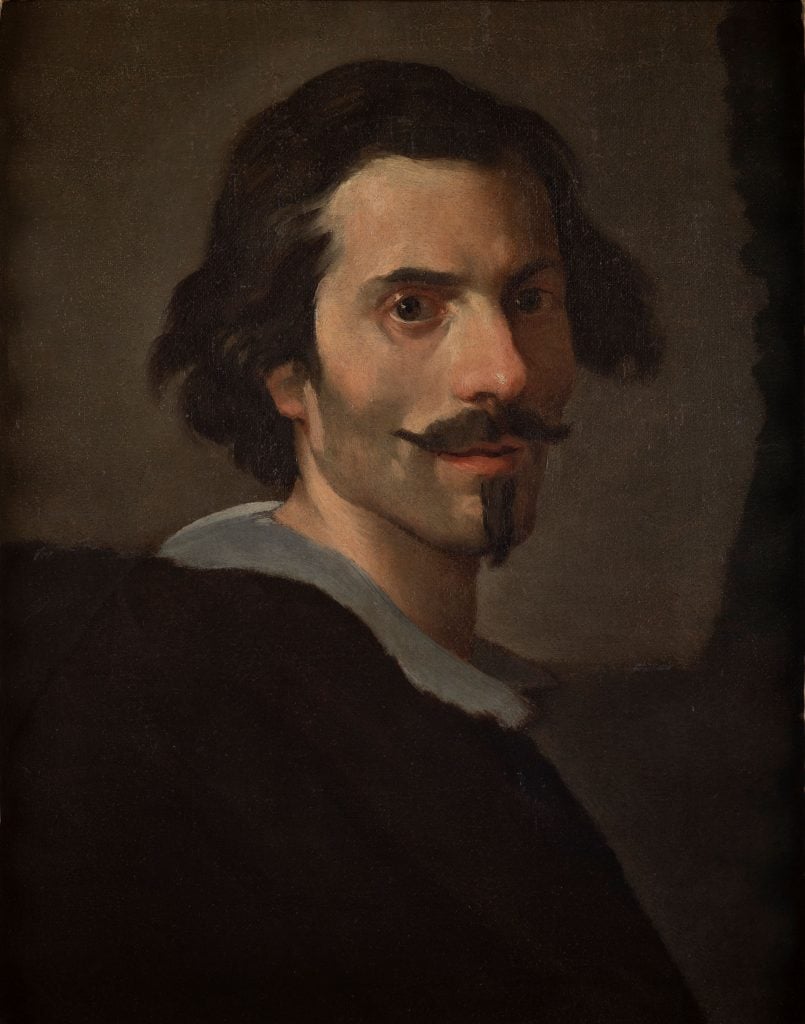
Gian Lorenzo Bernini, Self-portrait at a Mature Age , circa 1638–40, oil on canvas, 21 x 17 in. Galleria Borghese, Rome. © Galleria Borghese / ph. Mauro Coen.
“It was sort of megalomaniacal,” Andrea Bacchi, a co-curator of “Bernini e i Barberini,” said. “Rome was not a huge town. But they built these enormous buildings to show off how powerful and great the Roman Catholic Church was.”
Visitors to the Eternal City still marvel at what they created: the lavish palazzos and elegant piazzas, the sublime churches and cathedrals, the statue-adorned bridges and fountains, the breathtaking vistas and quiet, spellbinding chapels.
“Rome was a great theater to stage art by the popes,” said Francesca Cappelletti, the director of Galleria Borghese in Rome. “They could model and remodel. So much of what you see in Rome today was commissioned by the popes.”
Is it fair to call the Holy Fathers the greatest art supporters of all time?

Bernini’s 100-foot-tall baldacchino is the focal point of St. Peter’s Basilica in Rome. He was in his 20s when he got the commission from Pope Urban VIII. Photo: Katya Kazakina
I have been thinking about this since returning from a trip to Rome last month. The Raphael blockbuster at the Metropolitan Museum of Art has heightened my fascination, while drawing huge crowds. Centuries later, the Baroque era, with its theatricality and grandiosity, continues to inspire awe.
“Popes have been great art patrons,” Bacchi said. “They spent a lot of money on visual propaganda, making Rome the most splendid city in Europe.”
Russia’s Catherine the Great, France’s Louis XIV, and England’s Charles I are ranked among the greatest art collectors in Western history, amassing treasures during their respective reigns. But a whole string of popes accumulated and deployed art over the course of many centuries.
Astonishing Beauty
Let’s start with the Sistine Chapel, the crown jewel of the Vatican Museum. It was built as a private chapel for Pope Sixtus IV, who ruled from 1471 to 1484 and who is considered the first collector-pope. He invited artists like Botticelli and Perugino to paint wall frescos and gave to Rome an ancient bronze sculpture of a she-wolf, a symbol of the city, laying the foundation for its Capitoline Museum, the first national public institution in Europe.
Pope Julius II began the construction of St. Peter’s Basilica in 1506 and commissioned Michelangelo to paint the chapel’s ceiling in 1508, which the artist did over the next four years, creating one of the greatest masterpieces in Western art. The pontiff also tapped an emerging artist named Raffaello to redecorate his private suite of four rooms with immersive floor-to-ceiling wall frescos. That took 16 years to complete.

A crowd touring the Sistine Chapel. Photo by Getty Images
Pope Leo X, a Medici whose papacy lasted from 1513 until 1521, accelerated the building of St. Peter’s Basilica and made Raphael Rome’s first curator of antiquities, tasked with protecting historically important archeological materials, according to Bacchi.
In 1536, Pope Paul III summoned Michelangelo back to cover the altar wall of the Sistine Chapel with a fresco of the Last Judgement and later put him in charge of the architectural plan for St. Peter’s Basilica.
But even as they were helping to create works of astonishing beauty, these rulers waged wars, authorized the brutal Inquisition, and persecuted Jews. Some also showed little reverence for ancient Roman relics, stripping marble from the Colosseum and metal from the Pantheon to use in St. Peter’s Basilica and for cannons.

Installation view, “Bernini e i Barberini,” 2026, Gallerie Nazionali di Arte Antica-Palazzo Barberini. Photo: Alberto Novelli
The background of cruelty is ever-present in Rome, even as you gasp at the city’s grandeur and elegance. History feels different there, more immediate and integrated with the present. Centuries feel like a blink of an eye.
Astronomical Costs
Some popes spared no expense to satisfy their aesthetic itches, occasionally leaving the church on the brink of bankruptcy.
Urban’s spending was so great—Bernini’s baldacchino (an altar canopy) for St. Peter’s cost about 200,000 scudi at a time when a skilled worker earned one scudo a day—that it ignited the ire of his successor, Pope Innocent X. Urban’s Barberini relatives had to go into exile and Bernini’s ascent was halted, temporarily.
But even Innocent (whose 1650 portrait by Velázquez so consumed Francis Bacon) couldn’t resist Bernini’s virtuosity in art and politics. He soon commissioned the artist to create one of Rome’s biggest tourist attractions: the Fontana dei Quattro Fiumi at the center of Piazza Navona.

Tourists at Fontana dei Quattro Fiumi (Fountain of the Four Rivers) by Bernini in Piazza Navona in Rome, Italy. Photo by Getty Images
Bernini’s 90-foot-tall, irresistibly symbolic feat dwarfed the nearby Fontana del Moro he had worked on under Urban. It comprises four muscular male figures, river gods, positioned around a massive rock, with an obelisk rising from their midst. The four rivers on different continents represented the Catholic Church’s reach across the globe, which was very much the papacy’s agenda du jour.
Even bigger projects lay ahead.
On Sunday, when Pope Leo XIV delivers Easter blessings outside of St. Peter’s Basilica, the annual ritual will draw crowds to St. Peter’s Square, which was designed by Bernini at the request of Pope Alexander VII. The artist made the piazza large enough to fit some 100,000 people, the entire population of Rome at the time. It took from 1656 to 1667 to complete. The four-column-deep colonnade, spanning out from the cathedral in two directions, like arms, was meant to create the sense of an embrace, as if the faithful were being held by the church.

A view from Ponte Sant’Angelo, where 10 statues of angels were designed by Gian Lorenzo Bernini at the request of Pope Clement IX. Photo: Katya Kazakina
In 1668, the next pope, Clement IX, asked Bernini to upgrade the statues on Ponte Sant’Angelo, a bridge built by the Roman Emperor Hadrian in the first century and later used by the pilgrims to cross the Tiber to reach St. Peter’s Basilica. Bernini designed 10 angels that are still perched along the pedestrian bridge, creating a dramatic, and often-photographed, framing of the Vatican.
A Prodigy
Bernini undertook his first large-scale project while still in his 20s. Urban wanted to honor Saint Peter’s tomb underneath the basilica with something special. The artist came up with a 100-foot-tall bronze baldacchino as the focal point of the opulent cathedral. (Picture a four-poster bed on steroids.) Supported by four 60-foot spiraling Solomonic columns, it culminates with a massive gilded cross. The structure features bees, the Barberini family’s heraldic symbol, leaving no doubt about who commissioned the work and the artist’s affiliation with the ruler.
“They created the Baroque style together,” Thomas Clement Salomon, the director of the Gallerie Nazionali di Arte Antica Palazzo Barberini–Galleria Corsini, said last week, of Bernini and Urban. “Bernini became a universal artist like Michelangelo was in the 16th century.”
Salomon was in New York for the opening of the Raphael exhibition at the Met, to which the Palazzo Barberini loaned La Fornarina, a 1518–19 jewel by Raphael.
The week of my arrival in Rome coincided with exciting news: Italy said that it had acquired Caravaggio’s circa 1598 Portrait of Maffeo Barberini for $35 million. The future pope is depicted as a determined-looking, 30-something man in a black robe.

Caravaggio, Portrait of Maffeo Barberini (ca. 1598) on view at “Caravaggio, The Portrait Revealed” at Palazzo Barberini 2024. Photo: Roberto Serra – Iguana Press / Getty Images.
Salomon said he worked hard to broker the deal. After discovering the work in a private collection, he exhibited it at the Palazzo Barberini’s Caravaggio show, which drew 450,000 visitors last year. It was the first time that it had been on view in public in decades. The painting will join the museum’s three other Caravaggio canvases in a dedicated gallery in the future, according to Salomon.
The museum’s “Bernini e i Barberini” exhibition, which is on view through June 14, includes many portraits of Urban by his protégé.
Barberini was a cardinal when he met the prodigy, who was then working at his father Pietro Bernini’s studio and already the talk of the town.

Installation view “Bernini e i Barberini,” 2026, Gallerie Nazionali di Arte Antica-Palazzo Barberini. Photo: Alberto Novelli
The first piece Barberini acquired by Bernini the son was a sublime marble statue of St. Sebastian, according to historic records cited in the exhibition. Bernini was too young to be paid directly, so the money went to his father, according to Bacchi.
Barberini “kept an eye” on the young man, and as a pope, he decided that Bernini “was the right artist to redefine Rome,” Cappelletti said.
At the age when most American kids are still in college, Bernini had completed tour-de-force marble sculptures for key collectors. His 1621 bust of Pope Paul V, who ruled from 1605 to 1621, was purchased by the Getty for $33 million in 2015 and is now on loan to the show at the Palazzo Barberini.

Gian Lorenzo Bernini, Apollo and Daphne at the Galleria Borghese. Photo: Katya Kazakina
Early works created for Cardinal Scipione Borghese still dazzle at the Galleria Borghese.
“When he makes a marble sculpture, Bernini wants to portray the most important moment in the life of a person,” Bacchi said. “It’s a transitory moment, something that’s happening under your eyes, and he wants to show you the drama.”
In Apollo and Daphne (1622–25), it’s the moment of the nymph’s transformation into a tree. David (1623–24) is depicted as he is about to hurl the rock, defeating Goliath.
However it was Urban’s patronage that empowered Bernini to take his art into another dimension.
“Without Urban VIII, maybe Bernini would never have become an architect and urbanist,” Bacchi said. “He may have remained a wonderful sculptor.”
[ad_2]
Source link