
[ad_1]
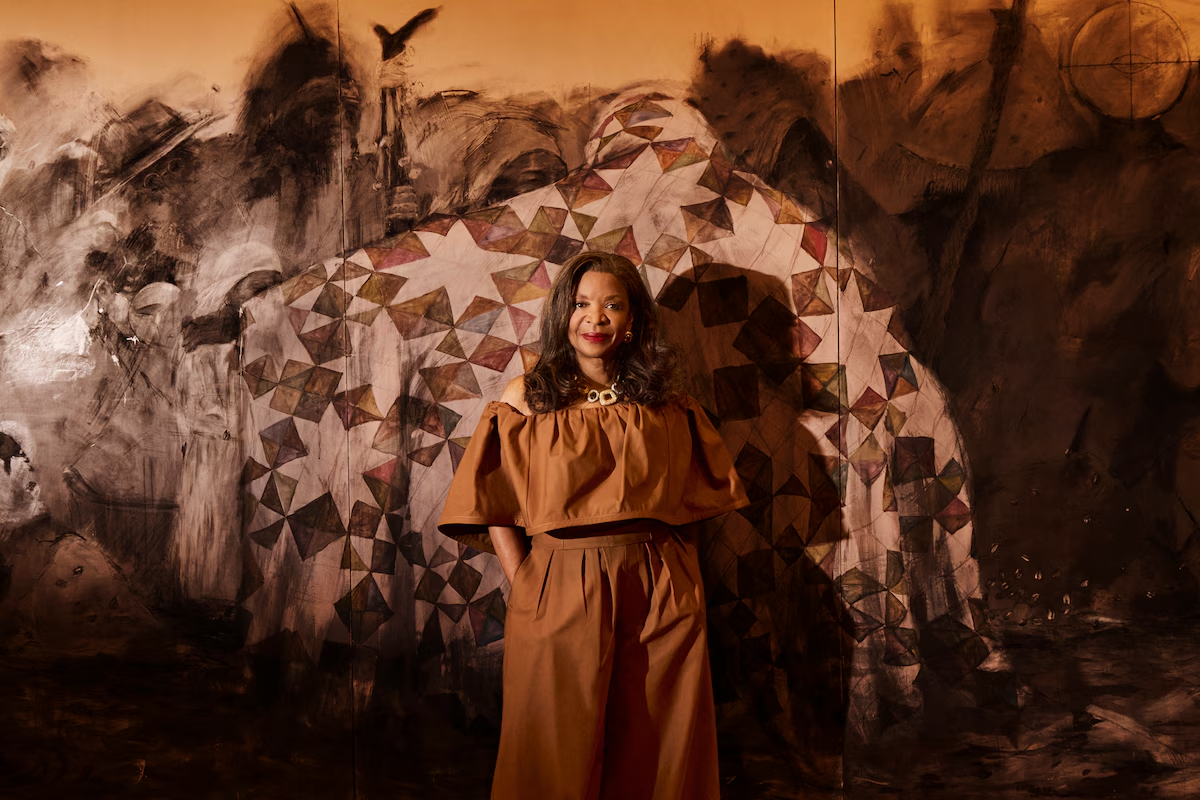
Pamela Joyner is out of wall space.
On a virtual tour of her Chelsea loft, the renowned art collector reveals her gigantic collection of abstract sculptures, installations and paintings, each arranged intimately beside the next in what has become a cross-functional living space, gallery and salon, where she hosts two dozen events each year.
The dense layout “might offend you aesthetically,” Joyner acknowledges as she points out towering works from Black artists Leonardo Drew, Suzanne Jackson, Charles Gaines and Firelei Báez, with reverence and adoration. “We think certain artists ought to be seen.”
Now retired after a successful business career in private equity, Joyner, 67, is relishing her role as a full-time collector of abstract art by African Americans and members of the global African diaspora. The niche collection, which totals close to 600 works (about half of which live inside her primary Nevada residence), spans about seven decades and began more than 30 years ago, when she purchased a Richard Mayhew painting. He quickly became a friend and mentor, introduced her to other Black artists, and eventually set her on a path of philanthropic and “mission-driven” work for excluded and underappreciated voices.
“The way I have operated in business and the way I have operated in the art world are exactly and precisely the same,” Joyner says. “They are focused on excellent outcomes.”

Though art collecting began as a hobby, it gained a clear directive in 2009, after Nicholas Serota — then director of the Tate Modern — asked Joyner to hop on a plane to London. The Tate Liverpool had just finished its well-received Afro-Modern exhibition, and Serota, aware of the depth of African work she’d amassed, wondered if she could fill in more of the museum’s blind spots. Joyner hadn’t really thought of her growing archive as a formal collection, but when Serota made the request, her perspective shifted.
“I took it as a call to action,” she says. “I said, ‘Okay, we’re going to have a mission and vision around this collection.’”
The mission itself was simple: “Try to influence the full arc of the art historical canon so that overlooked artists of African descent take their rightful place.” Over the last 15 years, Joyner has leaned on her Harvard MBA and marketing acumen to employ strategies that service that mission — purchasing work, showing it, lending it to museums, and making sure each piece lands in the permanent record through catalogues and publications. Since 2014, she’s expanded that effort even further by creating an artist residency in partnership with the Nevada Museum of Art, and serving as a trustee at the Art Institute of Chicago, MoMA and the San Francisco Museum of Modern Art, among other prestigious organizations.

Growing up in Chicago as the daughter of two teachers, Joyner said she “always had an appreciation for things that are beautiful,” frequently visiting museums and admiring the classical performing arts. But it was an early experience at the Art Institute seeing Georges Seurat’s “A Sunday Afternoon on the Island of La Grande Jatte” that forged a deep connection to visual art. The iconic work, part of the museum’s large collection of French impressionist paintings, fueled her imagination — and later, a love affair with Paris. “I don’t remember a time when I did not know and love that painting,” she says.
Around the time she began collecting, Joyner pivoted her interest to abstract artwork. Throughout the 1960s and 1970s, Black artists had little currency if they didn’t fit within specific parameters and styles. “The traditional art world didn’t assign validity to Black artists working with abstraction because there was just more comfort with the idea of Black creators creating images that were identifiably Black,” Joyner says. As a maverick herself, Joyner was drawn to abstract creatives like Mayhew, Sam Gilliam, Frank Bowling and Jack Whitten, who refused to be put in a box — and, as a result, had little or no documentation of their work and intertwined careers.

Without an art education background, Joyner leaned on various Black scholars and cobbled together archival material from unrecorded shows. She championed the abstract community by working with publishers (including Gregory R. Miller & Co., who also published “Four Generations: The Joyner/Giuffrida Collection of Abstract Art”) to produce various monographs, which help make up her home’s own large art book library. More recently, she’s opened up her collection to Brazilian artists (“Outside of Nigeria, Brazil has the largest Black population on the planet,” she says) and remains a vigilant, discerning purchaser.
“You have to hit the streets. You’ve got to go to a lot of galleries. You’ve got to go to a lot of museums,” she says. “You have to train your eye, have a sense of what appeals to you, but have a sense of the various visual languages.”
The work is ongoing and often rewarding, especially when, in her role as trustee, she can gently prompt curators with a simple, “Have you considered … ?” and a name they may have missed. She isn’t trying to impose her taste; she wants to nudge the experts. That includes encouraging them to look at both veteran artists and up-and-comers, like Sydney Cain, whose representational paintings hanging in her New York loft give off “an otherworldly faculty” and “stop me in my tracks,” Joyner says.
It’s a feeling that doesn’t get old. “The paintings do take you to another place,” she adds. “Every time you stand in front of one of these, you see something that you had not seen before.”
Over the next year, Joyner wants to devote more time to programming her three residencies, which provide space for pairs of artists as well as a dedicated museum show. She wants to focus on filling gaps in the collection and continuing to publish monographs of new artists. And, maybe most importantly, she wants to think about legacy, about the hundreds of rotating works that sit in storage and take up nearly every inch of her wall space. They’ve all prompted a very familiar and predictable boomer anxiety: “What are we going to do with all of this stuff?”
[ad_2]
Source link