
[ad_1]
The following is excerpted from Basquiat: The World of Jean-Michel, which will be released by Assouline on May 11.
When we were invited to contribute a few words to this book, we realized that this is a project that goes beyond an overview or a specific aspect of Basquiat’s multifaceted art, executed in a few short years. Sixty-six years after his birth and 38 years after his premature death, his short but incredibly intense life had an impact on his generation and those that followed. Without his contribution we cannot imagine today’s art world. The development of globalization and digitalization—along with a growing cultural focus on distinct identities and exceptional individuals—has helped spread his influence well beyond the art world.

Basquiat: The World of Jean-Michel (2026), published by Assouline. Photo courtesy of Assouline.
Artists who become part of art history are pioneers, as they change our idea of what art should and could be and how it should be viewed. Not only did Basquiat shift our understanding of art, he also shifted our perception of history and society in general. His work has become part of our visual memory but also provides insights into unnoticed collective memories. By merging images, symbols, and words, he perhaps wasn’t so much telling stories as he was retelling history or facts.
Cy Twombly once said that his own work leaves room for interpretation—as stories generally do. Jean-Michel’s work, in contrast, does not really do that, even though we think so and we occasionally still drive ourselves nearly crazy trying to interpret and understand. Instead, he bluntly shows us his facts, topics, and opinions—as little children do in their drawings, without the influence of a trained visual memory. Either we understand what we see or we don’t, whether we want to know his truth or we don’t.

Andy Warhol and Jean-Michel Basquiat. © AP Images / Richard Drew. Courtesy of Assouline.
This also stands in clear contrast to his older friend Andy Warhol, an artist who profoundly influenced not only Jean-Michel but an entire generation of artists and their successors up to the present day—the art age of “digital historicism,” as we call it. Yet despite Warhol’s impact, Jean-Michel’s artistic approach, with its critical engagement with politics and racism and its distinct expressive force, differed markedly from Warhol’s.
The younger artist was totally taken in by a person who was ahead of his time, who was white and did not have to fight for his rights. Warhol could just unemotionally express the beauty of art, without being critical or political, avoiding any meaning. He was mainly committed to art and style, processing the human output of his time—influenced by new technology, mass media, celebrity culture, globalization, commercialism, and digitalization—a time of rapid change, with endless possibilities and excesses. To reach Warhol’s level of historical importance, Jean-Michel had to establish his role and mission as an artist on a different level.

Jean-Michel Basquiat and Andy Warhol, Unit Filter GE (1984). Photo courtesy of Colour Themes.
To understand the person and convey his character, one can only recount personal experiences and encounters with him. In May 1982, I, Bruno Bischofberger, became Jean-Michel’s exclusive worldwide dealer until his death in 1988, and therefore was fortunate to accompany him through most of his life as an artist. His frequent visits to us in Switzerland proved formative—not only for Jean-Michel but also for me, my wife, Yoyo, and our four children, Lea, Nina, Cora, and Magnus.
I showed him everything that was important to me, and with his insatiable curiosity, he absorbed everything that was new to him. He was especially interested in my art and my other collections. In addition to visual art, these consisted of photography; 20th-century design; folk art, from an artistic and ethnographic point of view, made in Switzerland, Austria, Germany, and the other Alpine countries; and prehistoric stone objects from all over the world. Jean-Michel also showed a strong interest in Swiss history, cultural traditions, all kinds of music, food, and wine—and it didn’t take long before he knew a great deal about all of it.

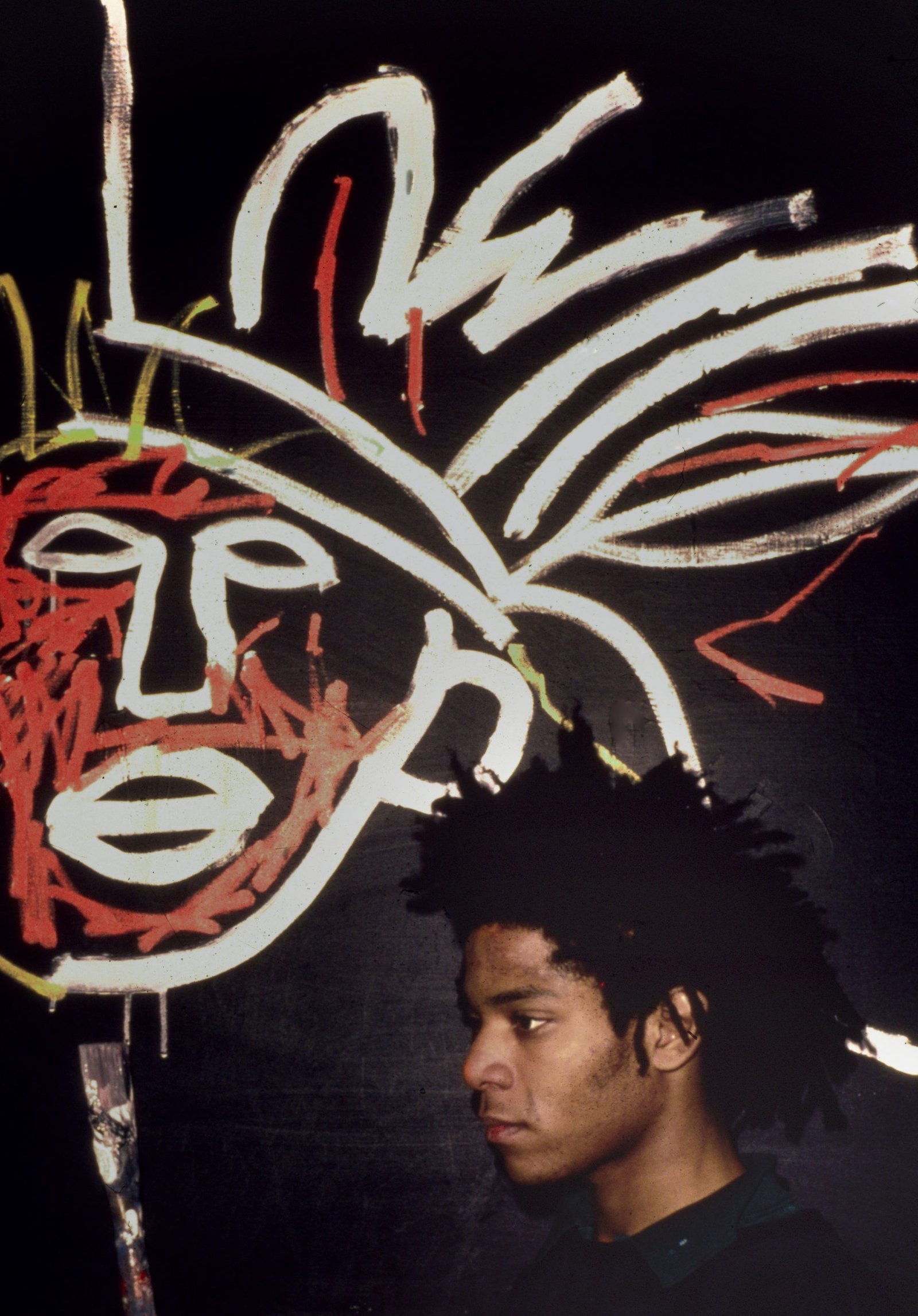
Jean-Michel Basquiat painting in his studio. © Marion Busch / Courtesy of Peter van Beveren, advisor contemporary art.
I learned a lot from him, too. On my first visit to his combination studio-apartment in New York, I asked him which artists had impressed and perhaps influenced him the most. The first thing he said was: “Works by very young children.” I, too, admired and collected my own children’s first creations. Of course, many had done so before me, especially artists. At the end of Picasso’s life, for instance, the artist explained that he’d always tried to paint like little children, but never really succeeded.
Jean-Michel was exceptionally intelligent, anticipated many developments, and influenced not only his contemporaries but artists throughout the following decades, up to the present day and no doubt beyond. He was a great artist, a fascinating interlocutor, and a wonderful friend to me, my wife, and my whole family.

Basquiat, Untitled (1982). © Estate of Jean-Michel Basquiat. Licensed by Artestar, New York. Courtesy of Assouline.
Today, we all can look back not only on his development as an artist but also on the development of art history and the history of the world. He and his sometimes radical “history” telling became an icon for an entire society, giving meaning to the term “Black Lives Matter” long before it became a transnational movement.
One can say that Basquiat became part of history, as he achieved an important change and reformed our perception of what art can be. He became a king of his generation as an artist and of Black and white culture and cultural diversity. His spirit is more omnipresent today than ever before—the entire world has made him a hero!
[ad_2]
Source link