
[ad_1]
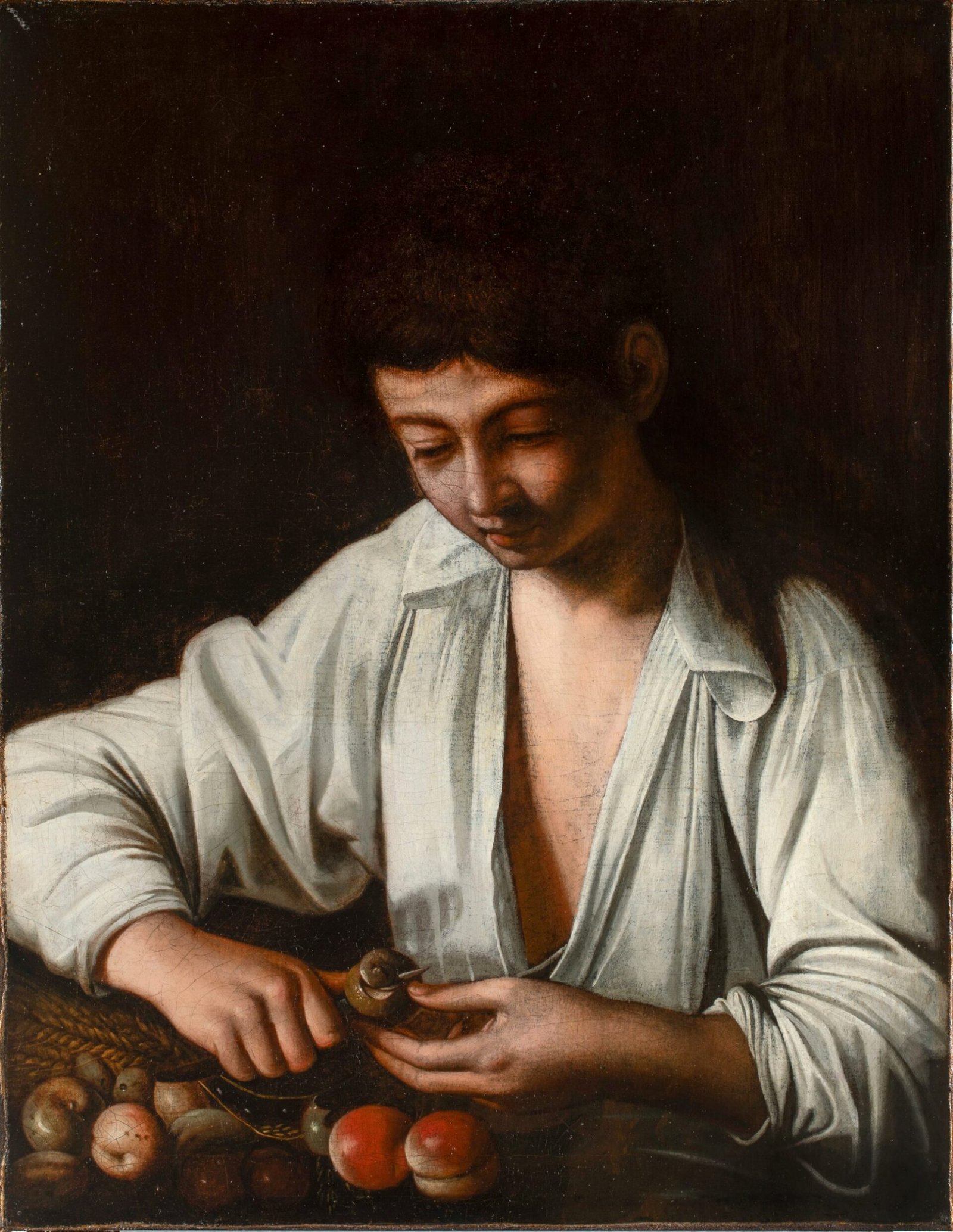
An Italian scholar claims he has discovered the earliest known painting by Caravaggio. There are several versions of the painter’s humble Boy Peeling Fruit, but Baroque art expert Gianni Papi says he has finally identified the lost original. If true, an x-ray analysis has resurfaced several modifications to the canvas that show the celebrated Italian artist had originally used it to paint a small dog.
When we think of Caravaggio, we think of the strikingly real interpretations of classic biblical scenes, their drama heightened by his masterful use of light and shadow. It was masterpieces like Judith Beheading Holofernes (ca. 1598) and David with the Head of Goliath (ca. 1609) that changed the course of Italian Baroque painting. They continue to wow contemporary audiences, most recently in a sweeping, scholarly survey at the Palazzo Barberini in Rome.
But before Caravaggio was ever heralded as a genius, he was just another impoverished artist struggling to survive in Rome. He had arrived from his native Milan at the age of 20 in 1592, fresh off a four-year apprenticeship. He eventually found work making simple paintings of flowers and fruit in the large workshop of artist Giuseppe Cesari.
Only a few of his compositions are known from this poorly documented period, of which Boy Peeling Fruit is the earliest. It may have been painted as early as 1592, before Caravaggio joined Cesari’s workshop, or in 1593, just shortly after. Some scholars think Caravaggio made and sold several versions of the work for petty cash, although it is also possible that some versions were copies made by others.
Some of the most high-profile versions belong to the Longhi Museum in Florence, Tokyo’s Ishizuka Collection, and the U.K.’s Royal Collection. Of the roughly ten that survive, cases have previously been made that several could be the original prototype.

A detail from Caravaggio’s Boy Peeling Fruit (1592-1593). Photo courtesy Gianni Papi.
Now, there is a new contender. The painting was described as a copy made “after” Caravaggio when it sold at auction in Europe last year. Its new owner must have suspected differently when he sought the expert opinion of Papi. After conducting various tests, the leading scholar on 17th-century art has publicly backed the work. He believes it is the lost original Boy Peeling Fruit, according to a report in El Pais.
From an initial study of the work, Papi concluded that the best preserved sections were consistent with the quality of Caravaggio’s hand. When the work was subjected to an x-ray analysis, however, the art historian was in for a surprise. Towards the bottom of the canvas, roughly between the boy’s hands and the fruit he is peeling, is the silhouette of a small dog looking upwards at the boy with its mouth half open.
What’s more, other areas show the ghostly remains of a landscape, supporting the theory that the canvas was reused. At some point, the support was also altered to adapt its size to the painter’s changing requirements.
Papi believes that this find is the “essential element in establishing authorship,” he told the Spanish paper. It provides some evidence that the artist was experimenting with different ideas before inventing the Boy Peeling Fruit composition, and that he was forced to be thrifty.
“Perhaps the dog was part of a previous composition,” Papi suggested. “It could have been the result of Caravaggio’s initial idea, and it brings to mind the allegorical image of Happiness: the black dog, Cornacchia, which the genius’s biographer, Giovanni Baglione, claimed was inseparable from Caravaggio.”
He believes that the dog’s snout was eventually turned into the shadows cast on the boy’s shirt by his hand and the fruit. “Now we understand why those same shadow areas are repeated in the rest of the different variations and what their origin is,” said Papi.
While the painting’s present owner remains anonymous, it appears they had a strong intuition that they may be handling a real Caravaggio. Is the painting currently being championed by Papi the very same painting, labelled Le jeune marchand de fruits, “after Caravaggio,” that was sold by Brussels auction house Horta on January 23, 2024? That lot was a sleeper hit, selling for 4401 percent of its €3,000 ($3,248) high estimate to fetch an impressive €135,000 ($146,182). It would appear the highest bidder knew something that the auction house didn’t.
If the painting is verified, even a price tag of $150,000 would be a steal. Last year, Caravaggio’s Ecce Homo sold to a British collector for €36 million ($39 million), a significant increase on the reserve price of just €1,500 ($1,780) that it was given before its authentication. Even this multimillion sum was a bargain compared to the $110 million that one collector is rumored to have paid in the mysterious private sale of a disputed Caravaggio discovered in an attic in France in 2014.
[ad_2]
Source link