
[ad_1]
Surrealist Painting Techniques
Ernst had no formal training and first learned to paint from his father, who was a technically skilled amateur painter. While his Dada and surrealist collage works, in his own words, were attempts at going “Beyond Painting,” (Ernst 1948) in the 1920s–40s he developed and adapted several experimental techniques to push the limits of painting and innovate traditional easel painting. His experiments took place during his intense involvement with the surrealist group in France and then in the United States, where he emigrated to during the Second World War. The wide range of experimental techniques explored here below alongside his dedication to collage came to characterize his artistic vocabulary and personal style.
Frottage and Grattage
The two techniques of frottage and grattage are closely associated with Ernst, who is often accredited with their invention. He started using frottage (“rubbing”) in his drawings in 1925. Captivated by the rough texture of his wooden floorboards, which evoked strange images for him, he covered them with a piece of paper, rubbing through the grainy texture using a soft pencil. He later commented on the process: “When I intensely stared at the drawing won in this manner (…) I was [word missing] by the sudden augmentation of my visionary facilities with contrasting and superimposed pictures.” (Stuttgart 1970, 4) The images created with frottage so served Ernst as a starting point, their suggestions of associations and interpretations inspiring ideas and compositions to be developed further.
Decalcomania
The technique of decalcomania, where paint is squeezed between two surfaces or pressed onto the canvas with glass panes or sheets of paper, was introduced to surrealist painting by the Spanish painter Óscar Domínguez in around 1935 and then taken up by others, like Ernst, in the late 1930s. Among the six works studied, the technique was consequently found predominantly in the paintings from the early 1940s, where it was used extensively both in The Attirement of the Bride (1940) and The Antipope (December 1941 – March 1942).
Macrophotographs taken of the latter demonstrate the varied ways Ernst employed decalcomania: In the background of the composition, he used it to depict trees or corals in the distance, seemingly without further reworking the applied paint with a brush. In the foreground, on the other hand, he used a fine brush to transform the shapes and lines suggested by the decalcomania, elaborating a detailed coral reef with shells and animals. He also made use of decalcomania to render the red robe of the figure on the left, which comes alive with movement and texture reminiscent of the transforming landscape below.
For a further discussion of the use of decalcomania in The Attirement of the Bride, see the dedicated article “Traditional and Modern: Max Ernst’s The Attirement of the Bride.”
Dripping
In Zoomorphic Couple (1933), Ernst first prepared a light gray base and then proceeded to splatter and blow on the black paint. He also thinned paint and applied it quickly or with the canvas lying flat, allowing it to freely run down the canvas on its own accord when placed in a vertical position, creating a coincidental but controlled pattern of lines running down organically across the composition in a ghostly manner.
Use of Objects
The artist also used objects and things other than a paint brush to apply paint to the canvases. In The Kiss and Zoomorphic Couple, he used a string. In the former, he dipped the string in paint and let it fall onto the prepared canvas – from the resulting lines, the composition was developed, and the artist would later paint over the lines again with a brush to emphasize them. In Zoomorphic Couple, on the other hand, he appears to have placed a paint-laden rope or string on the canvas, spraying over it with paint, so creating a kind of negative image.
In The Entire City, he most likely used textile printing blocks to apply a pattern and to give the effect of a city built of bricks. Due to surface abrasion, the effect is less visible than in the other works from the same series. In The Antipope, we see him use a leaf of a tree dipped into dark red paint to impress its veins and texture onto the canvas.
Traditional Approach
For the painting Garden Airplane Trap (1935–36), on the other hand, Ernst took a more traditional approach. In some areas, a preparatory drawing executed with pencil on the prepared canvas is visible, suggesting that Ernst planned the location and shape of the individual compositional elements in detail beforehand. In contrast to the other works, the artist appears to have painted the background first and then sequentially superimposed first the parallelepipeds, then the airplanes, and finally the other elements, such as the flowers, fruit, and leaves. The contrast between the sharp visible pencil marks of the geometric construction and the soft forms of the flowers and leaves underlines their organic nature.
Evolution of the Artist’s Palette
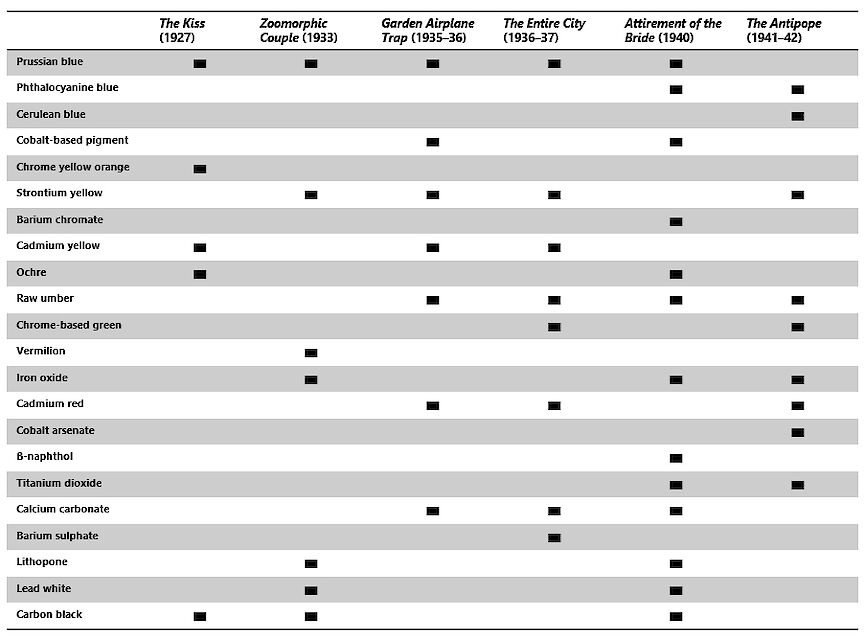
In addition to gaining an understanding of Ernst’s diverse use of surrealist painting techniques, the study of six works created over the course of fifteen years also provided a rare opportunity to examine the artist’s evolving palette. All works analyzed were found to be painted in oil paints (with a drying oil as paint binder) on commercially prepared canvases with a ground layer composed of lithopone and lead white. The investigation of the artist’s palette across the period 1927–42 suggested that the artist slowly replaced some of the more traditional pigments with innovative modern ones, which overall were less hazardous and had lightfastness and opacity.
For the earliest among the six paintings, The Kiss (1927), Ernst used a very small palette of only Prussian blue, chrome yellow-orange, cadmium yellow, ochre, and carbon black. While the next painting in the chronology, Zoomorphic Couple (1933), at first glance appears to have been painted with an even more limited palette based predominantly on light-dark contrasts, the analysis showed that Ernst painted yellow, blue, and red shades onto the dark tentacles of the figures, using Prussian blue, strontium yellow, vermillion and red iron oxide in addition to the more expected white and black pigments, lithopone, lead white, and carbon black.
Garden Airplane Trap (1935–36) is more colorful in appearance than Zoomorphic Couple but is composed of the same number of pigments. In the work, the artist used Prussian blue, a cobalt-based pigment, two kinds of yellow – strontium and cadmium yellow, a raw umber for brown, a cadmium red, and calcium carbonate (chalk), which was found in some of the works but could have been used as an extender in the paint formulation and not just as a white pigment. The slightly later The Entire City (1936–37) is composed of the same blue, red, brown, and yellows as Garden Airplane Trap, but the artist introduced a chrome-based green, which was also found in The Antipope. In most of the other paintings, Ernst would mix a green from blues and yellows.

Some trends could thus be observed: The red pigment vermilion, which as a mercury-sulfite could present a health hazard if not used properly, was slowly replaced by cadmium red (vermilion’s best color match) and ß-naphthol red, both introduced to the market at the beginning of the twentieth century as safer and more practical alternatives. Similarly, Titanium white, commercialized in the 1920s and 1930s, appears in the works after 1940, and in The Antipope, the latest work analyzed in the study, it is the main white pigment. Also Ernst’s blues evolved throughout the period studied: While Prussian blue is initially still used as the main blue pigment and on its own, when the 1930s Phthalocyanine blue, an innovative synthetic organic pigment, enters the artist’s palette, Prussian blue is used only as a mix-in and fully disappears in The Antipope.
State of Conservation
Any technical study of artworks in the collection is always also aimed at gaining information on the state of conservation of the works in the museum’s care. Analysis with ER-FTIR indicated the presence of both metal – specifically zinc – carboxylates (“metal soaps”) and oxalates in four out of the six paintings (they were not detected in Garden Airplane Trap and The Entire City). Since only one of them, The Kiss, contained zinc white, the presence of zinc in the other works is most likely due to its use as a drying agent (ZnO) or wetting agent and dispersant (zinc stearate) in the paint formulation. While the zinc soaps could have been originally present in that form in the tube, the oxalates constitute alteration products, which formed over time in the paint layers.
Publication
M. Zuena, L. Pensabene Buemi, L. Nodari, G. Subelyte, L. Stringari, B. Campanella, G. Lorenzetti, V. Palleschi, P. Tomasin, and S. Legnaioli. “Portrait of an artist at work: exploring Max Ernst’s surrealist techniques.” Heritage Science 10:139 (2022).
[ad_2]
Source link