
[ad_1]
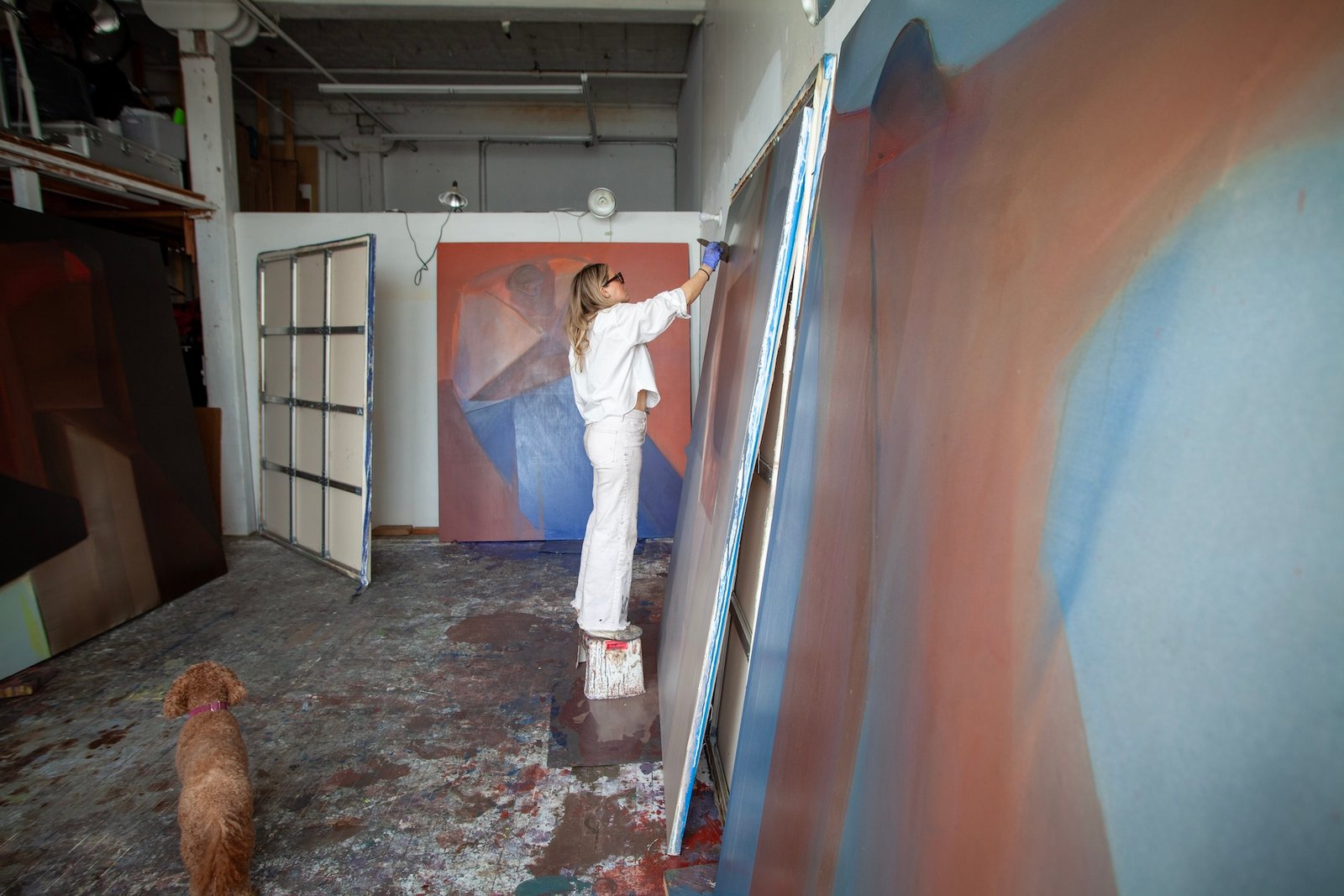
“I can’t promise you won’t get paint on you.” So says Heidi Hahn as she ushers me into her studio, warm and welcoming. Large canvases are scattered around the space, full of muted hues of oranges, reds, and blues. The paintings feel heavy. They sit on the floor, leaning up against the baseboards as if Hahn is giving her walls a much needed break.
Bodies of women take up the space of these works. They are so large it’s hard to tell where body begins and canvas ends. They are bent, self-contained, ominous. These are not archetypal women. They don’t have faces or recognizable feminine features. Their scale is exaggerated and monumental, pushing toward the boundary of abstraction and becoming closer to geometric shapes, pigment and texture more resembling a memory or a feeling more than any recognizable image of a woman.
Heidi isn’t interested in depicting your woman. In many ways, these paintings aren’t women at all. They are timeless totems, vessels stuck between ancient hieroglyphic and alien representations of women. They’re too abstract to pin down, but somehow elicit the question, “what does it mean to have a body?”
I get an electric blue streak of wet paint on my jacket. Heidi rushes over. “Don’t worry! Turpentine will get rid of everything.” Dabbing my jacket, watching the turpentine slowly absorb the pigment, surrounded by these shapes and bodies, I don’t necessarily see myself. I do, however, recognize a deep and familiar feeling. It’s a feeling of frustration. Wanting to be seen, to take up space, but simultaneously to blend with the background, not wanting to stand out; being not even sure what to say. Don’t look at me! See me! I am here! I am not your woman!
I can feel this tension in my posture sitting in front of Hahn, even though everything about her seems to say, “it’s ok, you can be comfortable here.” I can’t though—not really. Maybe that’s what a lifetime of being trained to hate your body does to you. To imagine my own body feels painful; I can only see an idealized version of the person I’ll never be, or an exaggerated version of what I am: a list of embarrassing and humiliating imperfections and mistakes to improve on. But to feel my body, really feel it, I don’t actually see those faults. I feel the shifting currents of different energies, from the vacuous space of emptiness in the middle of my chest, to (if i go really quiet) the pillar of energy running from the bottom of my feet to the top of my head, connecting me to something bigger than myself. Looking around me at Hahn’s paintings, I can see these empty spaces and pillars of energy too, and for a short moment, I feel seen.
The conversation that follows is an edited version of multiple meetings.
Thalia Stefaniuk: One of the first things you said when we started talking about your recent show “Not Your Woman” was that this work comes out of a sense of disappointment and a sense of failure–what do you mean by that?
Heidi Hahn: Every time I do a show, it’s very tumultuous. It has its ups and downs. It has a lot of doubt. It has a lot of negating, rebuilding, and re-contextualizing things. “Not Your Woman” was originally supposed to open at Mitchell-Innes & Nash’s Chelsea gallery but then the gallery suddenly shut down and the show was cancelled. So when I dealt with the fallout, I felt discarded, that I had failed In some way, even though these were circumstances beyond my control. You always have to see past the guarantees, towards the actual reality of the situation which might end in disappointment.
How did that fallout affect the work?
I let the paintings do what they wanted to do, and kept at it. I had to go back and untie them from such a strict notion of where I was going, because where I was going didn’t exist anymore. Their goals changed because I had no goals for them. I had nothing left for them. And in a way, that was very freeing. But there’s also a sadness to that. It was kind of like they were left behind, and that’s what the show was to me. The paintings had to live in their own making. I had a friend tell me, it’s almost like the paintings were painting themselves, and they’re going to keep working on themselves even after they’re finished. In that way, it looks like they’re still becoming something. And I think that’s actually a really sad and great idea, that they’re just becoming, that they’re on their way to something, and they’ll never get there, because they’re finished paintings.

Heidi Hahn, NOT YOUR WOMAN #8 (2025). Image courtesy the artist.
You often said that painting has a history but no future.
I’m very present when I’m painting. I don’t necessarily know what the aim is. I don’t know what they’re going to look like. The best times I’ve had in connection with the work is when I’m doing something and it feels like I haven’t done it before. It’s being uncomfortable the whole time so I’m able to make new moves. I can only move forward, but I don’t know where that forward is ever going to take me. I’m almost working from scratch, like nothing has ever existed before and there won’t be an existence after.
When you say “starting from scratch,” I actually have a hard time imagining that. Maybe you’re alone in the studio, but you’re such an engaged person in your community, in culture, and in the world in general–I just can’t help but imagine these timeless conversations that are all happening through you at the studio. How do you define starting from scratch?
I start from scratch materially. I always say this, I think I am not always a good artist, but I know I’m a good painter. I’m always thinking: How can I think about this idea, but through painting? And I think that’s what provides the work with that otherness, that drive. What’s going on politically, or what’s going on on a micro level in the community is always embedded in the work but I don’t want a one-to-one ratio with the paintings. They’re not reactive, I want them to kind of be timeless in that way.
I’ve been thinking about timelessness a lot in terms of the formal quality of the figures in this series. They feel kind of ancient and alien at the same time. It’s as if there’s something that’s almost beyond history. Formally, there seems to be a shift in this series from the rounded organic lines of your previous work to a structural, skeletal feeling in these new works that feels sharper and more geometric, almost architectural. Where does this shift come from?
I think they’re becoming more disassociated from the organic. They’re becoming more and more unknowable, and they’re becoming more of what’s beyond the body. And how I think about representing the body has shifted so much. I feel like I’ve been telling the same story, but I’m trying to tell it in many different ways, which relates to the question, how do you represent a body? How do you live in a body? How do you inherit a body? How do I represent these ideas in different ways with disparate ideas of paint material? I constantly want to shift this idea of how we deal with our bodies, especially in paint form, through a new kind of figuration. I’m very tired of just representation that doesn’t allow for any kind of tweaks or change, and that brings about a whole other interpretation of our bodies.
As you move more and more toward formal abstraction and play with this perception of what a body is, why is it still important to you to hold on to the idea of the female body specifically?
I can only speak about my own experiences growing up in this body. I was born female, and my relation to it changes. I’m still interested in that story. I don’t know if I’ll ever not be interested, because it’s how I relate to the world. If the work doesn’t have that kind of hook for me, I don’t know if I would relate to it in the same way. I’m not interested in landscape by itself. I’m not interested in abstraction by itself. For me, it always needs this container of a human experience and of this psyche and the psychological effects of living within a structure, and also I just don’t think I can answer it with anything I’ve ever done. So that’s why I’m always searching. It’s elusive. It’s so mysterious to us, we’re such a small part of it, of our own body, of collective bodies, in that way, that it’s very interesting to me.
You once told me that you feel like the paintings of this series wanted to be simplified. How does that push toward formal simplification lend itself to answering these questions about bodies?
Sometimes I complicate things too much because I want to do all of this stuff in one painting. I think I’m a better editor, if anything. And so I throw everything in just to take it out.
I don’t think something complicated is necessarily better. And so for me is key to take away things and to feel the loss in it, and to admit I don’t have to put everything into this one thing. Maybe just this one gesture is going to have to carry everything. Maybe I’m being selfish with it and not wanting to give everything to them. So I feel like I’m emptying out with this series and going back into finding what’s necessary and discovering the most basic level that these paintings can function on and putting that out there. I think that’s what was important to me, that I took away almost everything, so people didn’t have options. I don’t feel like I have options, so I put that in the work.
Do you still agree with the amount you took away, or are you striving for an even greater simplicity?
It’s so strange. The work is seemingly simple, but it was not. Sometimes you have to work so hard for things to look easy. When I was looking at “Not Your Woman” as a whole show I saw how hard that work was working to be simple.
I think since “Not Your Woman” was so difficult to complete, the next body of work may learn from that and become the thing I had wanted most for this show. I’m always trying to get to the heart of the matter and it’s never an easy task. The work is always trying to function in one way, and you’re trying to manipulate that, and you’re trying to do something else. Plus, I kind of have amnesia about the work. I always forget how difficult the process was, so I’m just gonna start again.

Heidi Hahn, NOT YOUR WOMAN #9 (2025). Image courtesy the artist.
Even if you have that amnesia toward the past work, do you feel like you store that memory in your body? Is your body and your mind something you are constantly trying to keep in conversation or do you feel more of a divide between your intellectual and somatic senses?
It’s strange because I have to forget my body in here. As I get older and the work is so rigorous I really have to forget my body in order to not feel limited by it. But also, you have these physical limitations with what you can do with the paint. It’s actually a very scientific thing, building up these surfaces. Sometimes you don’t remember the recipes. It’s almost like you’re just cooking, and you’re like, Oh, I left the vanilla out. So then it just ruins everything, and I have to start over.
There’s also a pleasure in putting the brush to the canvas and being able to make big gestures. Growing up, I felt like I had to be quiet or not quite seen, or I took myself seriously, but other people didn’t. In the studio is the only time I feel like I’m able to be 100 percent assertive, even nowadays. I don’t feel I’m able to do that in my career. I don’t feel like I’m able to have any agency right now in it. So to have that kind of power within the work—for me, that’s why I enjoy the act of painting. That freedom doesn’t exist for me in any other space, except for when I’m working and I think you can sense it in the work itself.
The work is big, the work is bold, the work is confident. The work is everything I want it to be. It’s for me to feel the power. Maybe other people can look at it and borrow from that.
I can tell you that I’m borrowing from it. How do you protect that confidence during bouts of insecurity?
In the work, there is no place for insecurity. You have to create something that’s bulletproof to no second-guessing about it. Do I think I’m always making the best work? No. But I know 100 percent that while I’m doing it, I don’t have the insecurity, and that’s separate from having doubt.
Yes, these works range a lot because, again, they fail. There’s doubt embedded that’s inherent to work. If you don’t have any doubt, then I don’t know what you’re doing. The conceptual part of painting has a lot of doubt but that’s separate from having an insecurity about being able to step up and give the work what it needs. I always have to be able to answer yes with that—whether or not it works, that’s beside the point. You really have to have a sense that no one can take this away from you.
I will always be a painter, even if my body fails me, I will think like a painter. I will approach life as a painter. And I have to believe that matters, even if what I’m doing is not working, I still have to believe in the process. I have hope in the fact that I will want to make another painting.
[ad_2]
Source link