
[ad_1]
By Wilson Kerr — Columnist
Like many, when I think of Henry David Thoreau, solitary contemplation comes to mind. His writings convey and champion introspection and a deep connection to nature forged by time spent alone.
In “Walden” he wrote, “not till we have lost the world do we begin to find ourselves.”
On a recent Sunday afternoon, my phone buzzed and reminded me of a “Thoreau Walk” to begin in 20 minutes. It was in my calendar from an events whiteboard at a Conservation Coffee a few weeks prior.
Without looking up the details, I filled a water bottle, grabbed my vest and a daypack, and drove to First Parish Church. An outdoorsy-looking crowd was gathered, awaiting instructions and applying tick repellent to pants tucked into socks.
Familiar faces
It was a warm, beautiful, bright spring day, and I recognized Janet and a few others. Bob introduced himself and reminded me that we’d met at Concord Rod & Gun Club years before, and Peter thanked me for promptly sending a check for his new book. After a quick safety announcement by Brad, who’d organized the event, we were off.
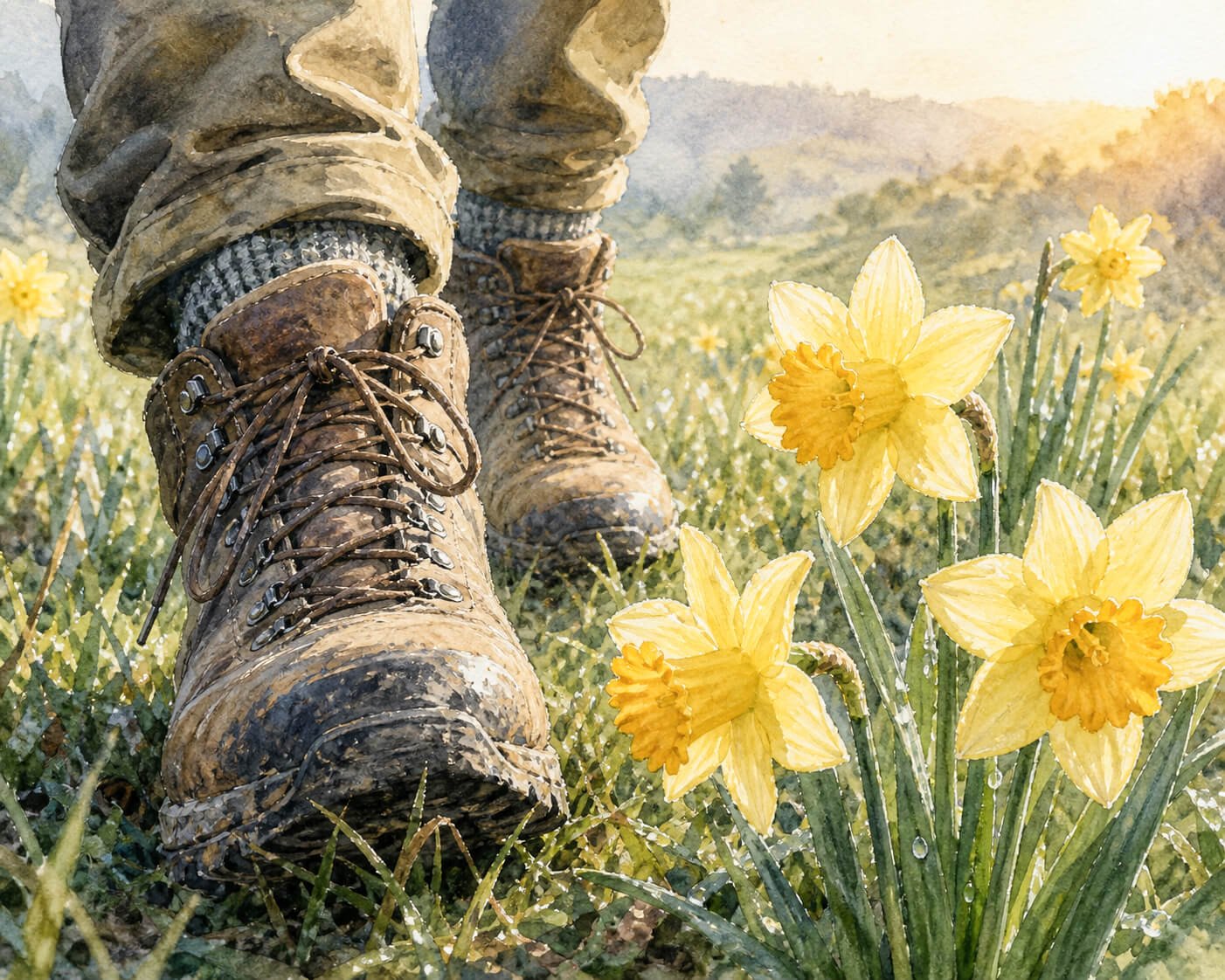
In small groups we walked east along Lexington Street, crossing Heywood Meadows. The daffodils were up, and the tree buds were so close to blooming into leaves we could feel it. Just before a white house, a boardwalk path on the right departed the meadow, and we noticed a small sign reading “Emerson Thoreau Amble” and an arrow.
A few of us stopped at the marker. Opened in 2013 and maintained by the town, this “amble” retraces the likely route Ralph Waldo Emerson, Thoreau, and others took from Emerson’s house to Walden Pond.
This ground and the path ahead contributed to a literary movement of the mid-1800s called American Transcendentalism that promoted simple living and a personal connection to nature. Emerson considered the natural world a living, sacred place for self-reflection and personal growth, rather than a commodity for our use. At the time, that was a radical notion.
Thoreau lived with Emerson in the nearby white house from 1841-43, and Emerson’s mentoring no doubt influenced his decision to test these ideas via his experiment in self-reliance from 1845-47 at Walden Pond.
Walking and talking
The skunk cabbage shoots were so green and bright along Mill Brook as to look artificial. Pamela pointed out how blue the sky looked through her polarized sunglasses, and several of us noted owl pellets among the pine needles. I learned about Alice’s love of Aldo Leopold’s “Sand County Almanac.”
Thoreau had walked here, too, talking and philosophizing with Emerson, Margaret Fuller, Amos Bronson Alcott, Louisa May Alcott, Elizabeth Peabody, Nathaniel Hawthorne, and others. And here we were, nearly two centuries later, learning from one another just as those luminaries had.
It felt as if the energy of these early Concordians was still there, mingling with the sights and smells of the forest, fueling conversations among strangers brought together by a desire to do something new and different on a Sunday afternoon.
We passed the old ice house, up the hill into the oaks and maples of what was the farm of Brister Freeman, a formerly enslaved person who earned his freedom in the Revolutionary War.
After crossing Route 2, we arrived at Walden’s cabin site to find others already there, having walked in from Lincoln. Music, poetry, and a description of Walden’s life and times by historian Richard Smith followed. There were calls to action in honor of Earth Day, and I wondered what Thoreau would think of this lively scene. Light sparkled off the pond through the trees as Brad thanked all for coming, and I took it to signify appreciative applause.
On the way back, new conversations sprang up about blue jays as mimics, and gall wasp puff balls, and the work Nathan was doing with MassEnergize on local climate action. As we ambled along, I realized that it was not always necessary to be alone and quiet to appreciate nature. On this day, it was the people, the conversations, and our shared interests that made the moment special.
A sociable sort
Thoreau was not a hermit. As we had just discovered, his cabin was a relatively short walk from Concord Center. He often ventured into town, hosted visitors, attended dinners, and even threw watermelon tasting parties. While solitude and the quiet beauty of the pond certainly inspired his journal entries that would become “Walden” seven years later, his friends and mentors were close by, and he saw them often.
In April 1851, Bronson Alcott wrote in his journal: “All the morning was given to conversation in [Emerson’s] study. After dinner we walked to Walden, and in the evening came Thoreau and Elizabeth Hoar and stayed till 10 o’clock. There was endlessly varied and miscellaneous discourse.”
As I drove home, I felt fortunate to live in a town so steeped in history. A community of informed citizens who care to organize ambles and invite others to walk in the footsteps of those who first popularized spending time in nature as having intrinsic value. Like us, they did it together, listening and learning.
I hope you will spend Time Outdoors this spring discovering the “Amble,” and if you do, perhaps you will feel whispers of guidance from the past and engage in “varied and miscellaneous discourse” with your companions or those you meet along the way. I bet Walden’s waters will sparkle with their approval.
Wilson Kerr lives in Concord and is an avid outdoorsman and amateur naturalist. This monthly column is written to help grow awareness of the wonders of nature. In this increasingly fast-paced and technology-packed world, it is important to stop and take in the beauty of our area and the animals that inhabit it. The author hopes this column will be read by families and used as a teaching tool and that you will spend more … Time Outdoors.

[ad_2]
Source link