

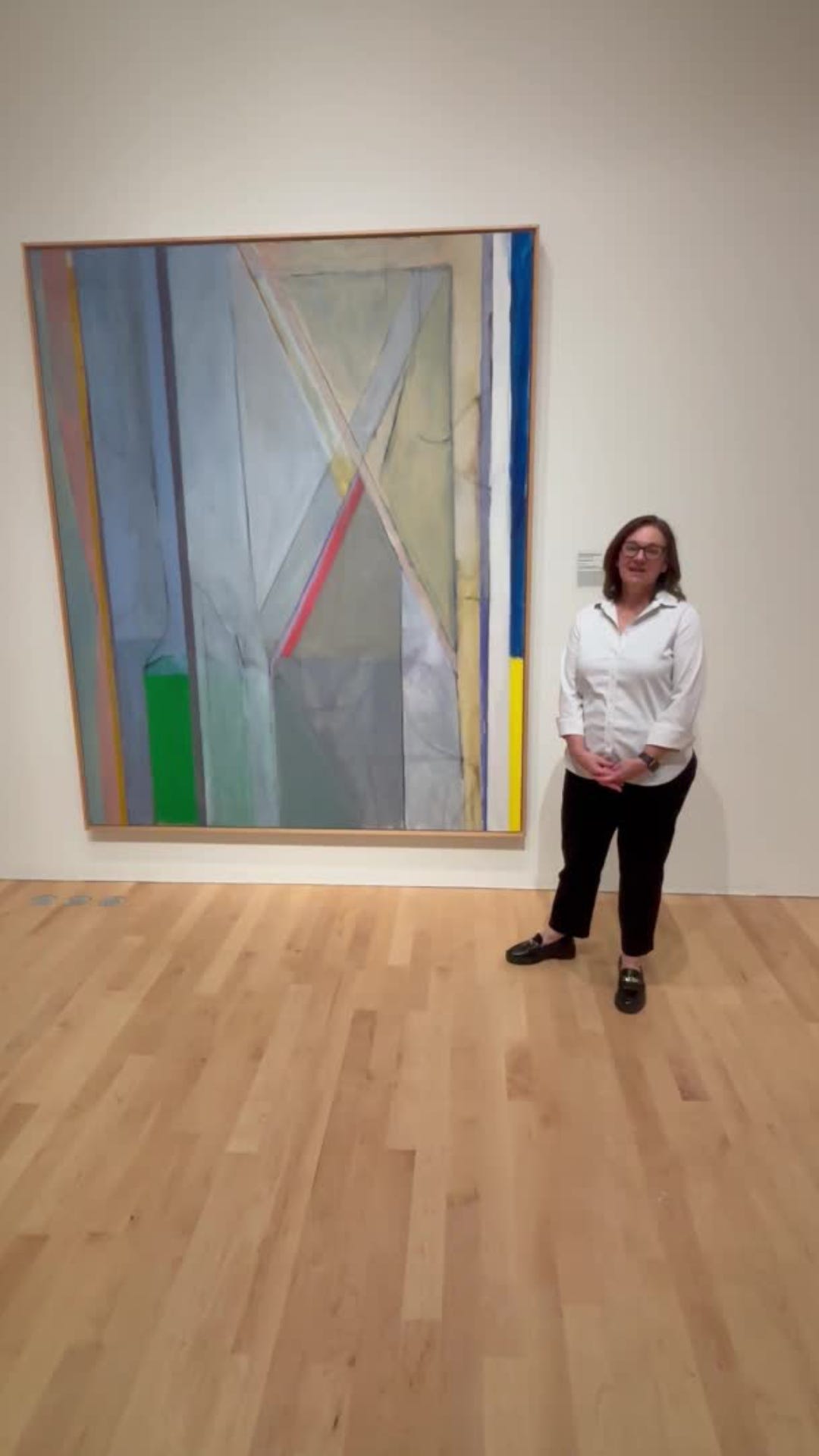

Margaret Andera discusses ‘Ocean Park #16’ at Milwaukee Art Museum
Milwaukee Art Museum Senior Curator Margaret Andera talks about “Ocean PArk #16,” a painting by Richard Diebenkorn at Milwaukee Art Museum
- A new exhibit at the Milwaukee Art Museum highlights 20th-century artworks donated by Peg Bradley.
- The Milwaukee museum opened a new addition in 1975 to make room for the nearly 400 works Bradley donated.
- Bradley’s turn from French to German art is a key element in the story of her collection.
It would be a stretch to say the Milwaukee Art Museum is the house that Peg Bradley built.
Yet, “without her, we don’t have the Kahler building … we don’t have the Calatrava building,” said MAM Chief of Curatorial Affairs Liz Siegel.
Bradley’s donation, completed in 1975 when the new Kahler addition was opened, of nearly 400 20th-century artworks is a gift that keeps giving. It includes some of the most familiar works in MAM’s collection, such as Picasso’s “The Cock of the Liberation” (1944) and Alex Katz’s “Sunny #4” (1971). It boasts nearly a dozen works by German expressionist Gabriele Münter, for which MAM receives more loan requests from other institutions than it could ever say yes to. The collection also contains an attractive cluster of paintings by Wisconsin native Georgia O’Keeffe, the most displayed female artist across American art museum collections.
To celebrate the 50th anniversary of Bradley’s gift, MAM curators have selected and installed 94 works in the newly opened exhibit, “The Bradley Collection of Modern Art: A Bold Vision for Milwaukee.”
These paintings, sculptures and works on paper were chosen to offer the “best representations” of what Bradley collected, especially in her areas of strength, but also with an eye on the breadth and expansiveness of her interests, said Margaret Andera, senior curator of contemporary art.
“The collection Bradley assembled is practically synonymous with modern art at the museum,” Siegel wrote in her catalog essay.
A major gift to Milwaukee, but with a condition attached
Born Margaret Blakney in 1894, she graduated from Milwaukee’s East High School, now known as Riverside University High School. In 1926 she married Harry Lynde Bradley, one of the founders of the Allen-Bradley Co. When the stock market crashed in 1929, Peg Bradley went to work at the Zita dress shop to pay off her substantial bill. Liking the fashion business, she stayed connected to Zita long after she settled her debt, buying control of the company in 1949.
One of her first serious art purchases was a Georges Braque painting, “In Drydock” (1942), acquired from a New York dealer in 1950. (It’s among the works in MAM’s new exhibit.) Her collecting took off; by the time Harry died in 1965, the couple had acquired more than 200 works. Eventually Peg would have more art than could comfortably fit in her six homes and offices.
In 1970, Peg Bradley, who had been giving to the institution for years, announced her plan to donate her collection to the local art museum, provided that it build an expansion to contain it. (At the time, her collection was valued at $11 million.)
“Both the institution and local journalists took pains to explain that this was not intended as a personal monument or an expression of vanity but rather as a challenge to finally create the much-needed space to display the permanent collection,” Siegel wrote in her catalog essay. At that time the museum, still called the Milwaukee Art Center, was entirely contained within the Eero Saarinen-designed War Memorial Center.
Bradley first funded a preparatory study for the expansion, then contributed $1 million (half her funds, half from the Allen-Bradley Foundation) toward the cost of building it. The three-story addition, designed by David Kahler, opened on Sept. 21, 1975, quadrupling available exhibition space. Siegel’s essay quotes praise by Milwaukee Sentinel art critic Dean Jensen: the heft provided by the Bradley gift and the new addition meant the Milwaukee institution “now can properly be ranked with the 20 or 25 most important art museums in the nation.”
The Kahler addition also had a quirky hidden feature: an apartment, decorated by Bradley, that could be used to entertain donors and potential art givers. (That apartment was converted into additional gallery space during a 2014 reinstallation.)
In 1980 the expanded institution changed its name to Milwaukee Art Museum.
For the new exhibit “The Bradley Collection of Modern Art,” the 94 selected works have traveled from their home in the Kahler building to the now-iconic Santiago Calatrava addition, which opened in 2001. After this exhibit closes, MAM will reorganize and reinstall its 20th-century artwork in the Kahler building with a planned reopening in spring 2026.
A passion for French art, then German, and also color
Bradley’s timing for emerging as a serious collector in the 1950s “was perfect, as both national and personal postwar prosperity lined up with movements in the art market to enable a rapid pace of collecting from galleries across the United States and Europe,” Siegel wrote in her essay.
But the Bradleys were smart shoppers who didn’t simply fling money around. Peg’s early passion was for French artists such as Pierre Bonnard, Raoul Dufy and Fernand Léger. But when rising prices placed the work of artists such as Henri Matisse and Paul Gauguin beyond her reach, “she makes a really inspired choice to start collecting German art, and that’s one of the places where she’s really different from a lot of other collections,” Siegel said. Works Bradley collected from such German Expressionists Ernst Ludwig Kirchner, Paul Klee and Münter became a strength of her collection and of MAM’s widely recognized holdings from this period in art history. In both her catalog essay and an interview, Siegel said it’s possible Milwaukee’s strong German heritage played a role in this turn. But speaking realistically, the German works were more affordable and available then, Siegel said.
“I seem to have some sense of line or color or something,” Bradley said modestly in a 1970 Milwaukee Journal interview, loosely connecting her eye for fashion with her eye for art.
But Andera, the senior curator at MAM, pushed back firmly against any notion that Bradley’s interest in color was lightweight or easy. “She had an adventurous and an avant-garde eye for color,” Andera said. Pointing to Münter’s “Portrait of a Young Woman” (1909), one of this collection’s signature works, Andera called it “revolutionary use of color,” not easy.
In her catalog essay “Color in the Corners,” Caitlin Haskell, a senior curator at the Art Institute of Chicago, credited Bradley with being attuned to how use of color in 20th-century art was rapidly, and sometimes radically, changing.
However, you can’t put Peg Bradley in a little box as a collector. This subset of her collection on view at MAM also includes works that pay little attention to color, such as Victory Vasarely’s trippy black-and-white op art painting “Sir-Ris” (circa 1957). Even the art museum’s new director, Kim Sajet, couldn’t resist taking a selfie with that work.
This exhibit also features five paintings by Georgia O’Keeffe, the artist born in Sun Prairie, including the familiar “Poppies” (1950) and the luminous “Pelvis I” (1944), where the animal bone seems to rise off the canvas three-dimensionally. O’Keeffe fans will want to read the catalog essay by Sarah Kelly Oehler, a curator at the Art Institute of Chicago, about the connection that developed between Bradley and O’Keeffe and to what extent either woman viewed herself as a feminist.
The bold vision doesn’t stop with this exhibit, which continues through Jan. 18. A companion exhibit, “Looking Forward: New Gifts of Art” from Nov. 7 to Feb. 15, 2026, will show recent and promised gifts of art from current donors.
“In the 50 years since the new wing’s opening, the Bradley Collection has been reinstalled several times, and each time it becomes less a product of one woman’s vision and more a part of the fabric of a civic museum,” Siegel wrote. That process will continue when the Bradley works return to the Kahler and are reintegrated with other art in MAM’s permanent 20th-century exhibit, with dedicated rooms for artists such as O’Keeffe and Münter.
But for the curators who live and work with the art Peg Bradley collected, her stature remains high.
“Bradley’s example … demonstrates the transformational impact that one person can have on an institution and a community — an impact that extends even beyond their original intentions,” Siegel wrote.
If you go
“The Bradley Collection of Modern Art: A Bold Vision for Milwaukee” continues through Jan. 19, 2026, at the Milwaukee Art Museum, 700 N. Art Museum Drive. For more information, visit mam.org or call (414) 224-3200.