

Jeremy K. Simien is a well-known connoisseur of antique Louisiana paintings, furniture and fine craft. In particular, the 40-year-old Baton Rouge art collector seeks out items that call attention to slavery and race relations in colonial and pre-Civil War society. It can be a splintery area of specialization, since not everyone cares to be reminded of past societal ills.
Years back, Simien said, he asked a museum director why there was so little historical evidence of people of color in the institution’s collection. The director, whom Simien declined to name, said that such artifacts just didn’t exist or couldn’t be found anyway. With that, Simien embarked on a sometimes quixotic quest.
In time, he discovered that evidence of antebellum slavery and the historical contributions of non-Europeans certainly exists, though often it’s been swept under the rug. Simien believes it’s imperative to find such artworks and objects and suss out their meanings. And it’s especially important that a person of color, like himself, do so.
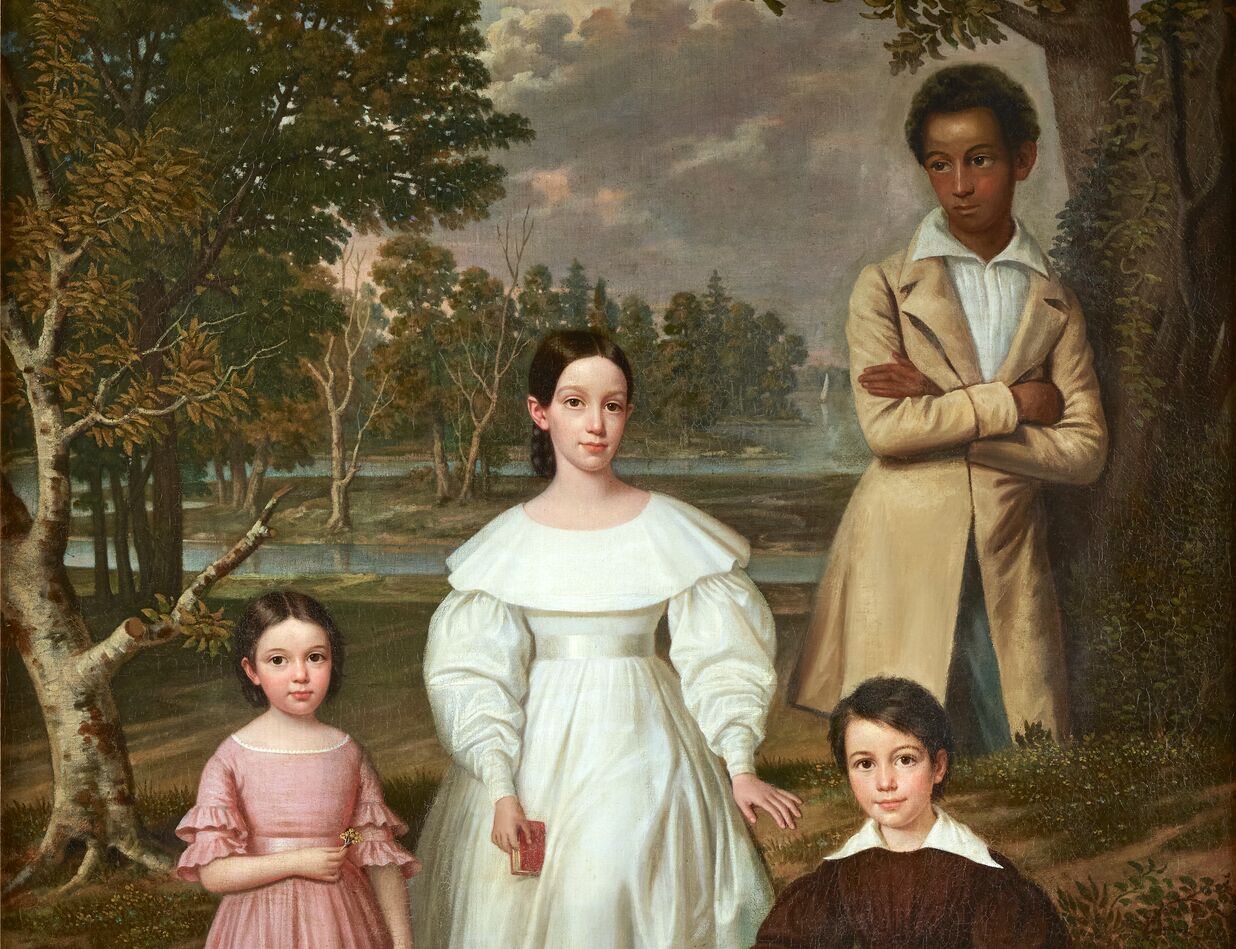
In an 1837 painting, a Black teenager stands beside a trio of White children. A recent historical discovery found that the young New Orleanian was an enslaved household servant named Bélizaire.
Bringing back Bélizaire
In 2021, Simien became an overnight star of the national antique art scene, when he tracked down and purchased a mysterious 1837 group portrait, possibly painted by master Jacques Amans, that was long rumored to include a blotted-out portrait of an enslaved teen.
The young man, named Bélizaire, was the household servant of a wealthy, White, French Quarter family. His job may have been to watch over the master’s three children, who are also featured on the canvas. He was included in the family portrait almost as if he were an equal. But, decades after the group portrait was painted, in the feverish segregationism of the Jim Crow era, somebody carefully painted over poor Bélizaire like he’d never been there.
By the time Simien bought the group portrait, Bélizaire had been uncovered by an art conservator, but his identity was still unknown. Simien had the painting thoroughly restored and hired a researcher to assist in sleuthing the enslaved teen’s backstory. Thereafter, the painting became a sensation, a tangible symbol of the Black Lives Matter movement.
Bélizaire and his three wards ended up in the Metropolitan Museum of Art in New York, and Simien ended up in the pages of the New York Times, the Smithsonian Magazine, and all over the antique art trade magazines.
After being blotted out for so long, he wanted Bélizaire to take a bow in the brightest spotlight possible.

Historian and art collector Jeremy Simien explains the history of the families featured in his Baton Rouge collection on Thursday, November 6, 2025.
Time Pieces
Simien was an only child, born into a family of successful lawyers. He attended a private Christian high school — an experience he found so distasteful he won’t share the name. He planned to go to college, but never got around to it. Instead, he sang, played keyboards and handled the electronic tracks for a bygone band called Desolo, which, he’s proud to point out, performed nothing but originals.
As a musician, he said, he found himself hanging out in pawn shops a lot, searching for hocked equipment. While there, he explained, his eyes fell on other treasures as well. These days, Simien has come to believe that Swiss watches like Rolexes are a bit gauche. They’re ponderous, ostentatious and just too popular on the resale market. But back then, he found them irresistible.
Simien traded in used Rolexes and other collectible timepieces. He says he wasn’t drawn to pristine, never-been-used watches. He liked them to have a little scratch here and there, maybe worn during a tour in Vietnam or something like that. The watches were the tellers of time and also the bearers of history.
Are you insane?
In 2013, Simien had just gotten married, and he and his wife were filling their new gated-community home. So, he sold one of his vintage Rolexes to impulsively buy an exquisite 1815, Louisiana-made, inlaid armoire at auction. It cost $10,000. When he called his dad to tell him what he’d done, his father asked him, “Are you insane?”
Well, at least it wasn’t as crazy as the time he spent $400 for an original Betamax tape of the 1978 flasher classic “Halloween,” which turned out to be a fake. That was during his antique video technology phase.
The purchase of the rare Louisiana-made armoire proved that yet another obsession had kicked in. But this time it was a real passion. And it was personal. There aren’t a lot of people of color in the world of antique art collecting, and he planned to make a mark.

Historian and art collector Jeremy Simien inspects a miniature portrait in his Baton Rouge collection on Thursday, November 6, 2025.
Top hats, trade beads and gold watches
Central to Simien’s collecting are art and artifacts related to free people of color, the unique community of non-enslaved Blacks and mixed-race residents that shared New Orleans with fellow citizens of European descent before the Civil War. Most Americans probably don’t know that such a class of people even existed.
Simien said he’s drawn to the area of specialization in part because he descends from free people of color, as well as enslaved Africans, Native Americans, European colonists and others.
With a certain theatrical flair, Simien is known to wear the top hat of an antebellum gentleman on his head and a few strands of glass trade beads — symbolic of early international commerce between Europeans, Africans and Native Americans. Plus, on occasion, he straps a glittering, gold, non-Rolex watch on his wrist. It’s a sociologically complex fashion combination that says plenty about his worldview.
The message of the Bélizaire painting, Simien said at the time, was to “highlight New Orleans’ culture, the good, the bad, the Black, White and gray, the whole fusion.”

Historian and art collector Jeremy Simien pictured wearing his antique Spanish hat made in the late 19th century at his Baton Rouge collection on Thursday, November 6, 2025.
Finding self
The same philosophy applies to the collection of artworks that crowd the walls of his office, where a portrait of the slave-owning statesman Henry Clay — painted by an artist with a studio in the Pontalba apartments — shares space with a tiny portrait of an African American Union Army soldier.
Elsewhere, there’s a portrait of a female plantation owner, a portrait of a man who sold nautical instruments on Canal Street, and an etching of the Bernard de Marigny, the French gambler for whom the neighborhood is named. There’s also a couple of lithographs by the mysterious New Orleans illustrator and photographer Jules Lion, who was long thought to be a free man of color, but may have actually been of European/Jewish descent. Simien’s office décor is the whole fusion, for sure.
Simien believes that for him, collecting historical art is, in part, an exercise in “finding self.” In one case, the search led to a long-lost relative. Studying his genealogy, Simien became aware of an ancestor who was an officer in the mid-18th-century colonial Spanish army in Louisiana. He further discovered that in 1841, his great-great-great-great- great-grandfather had sat for a portrait.
Simien tracked the artwork to distant out-of-state cousins, who eventually agreed to allow him to purchase it. After some confusion, Simien discovered the painting actually depicted his great-great-great-great-great-grandfather’s son. Simien’s research revealed that the man in the picture wasn’t entirely of European descent as previously thought. He was of mixed race.
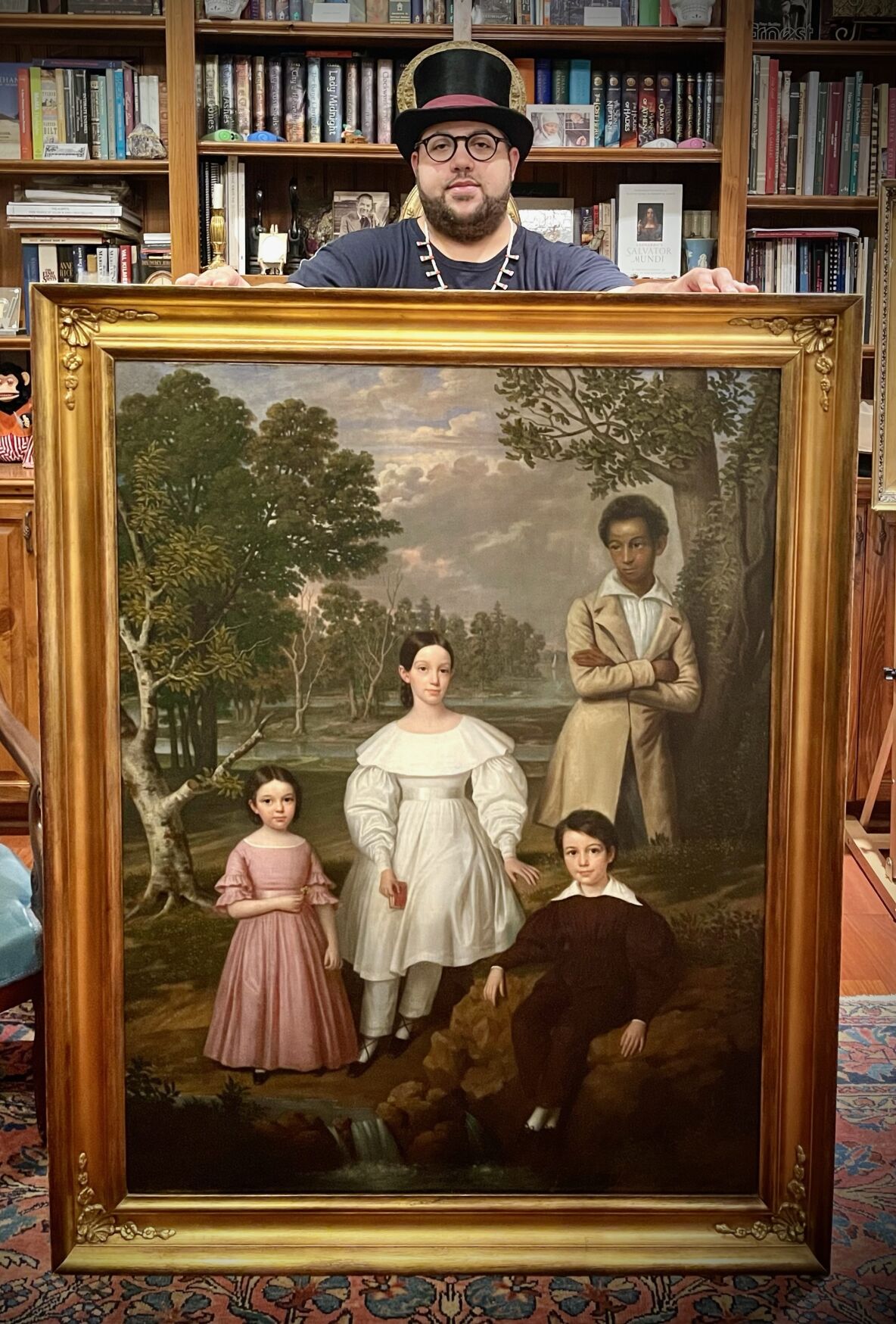
Jeremy K. Simien encountered an enigmatic 1837 New Orleans painting on the Internet, which included the compelling image of an enslaved teen named Bélizaire. His hunt for the artwork took years. (Photo courtesy Jeremy K. Simien) Painting of enslaved teen Bélizaire
Stepping on toes
“Foremost, Simien is a historian who is also a collector,” said Bradley Sumrall, senior curator at the Ogden Museum of Southern Art. “Once he’s attached to an object, he wants the whole history.”
As a person with a multi-racial background, “he didn’t see his story fully represented in the history books, in the art history books and in museums,” Sumrall said. “He was underrepresented and sometimes erased.”
Simien has a certain reputation for bluntness. He is quick with an unvarnished opinion and has occasionally rankled curators and auctioneers. He may not have burned bridges, but he’s not adverse to scorching them. He says it comes with the territory.
“It’s a full room. You can’t move without stepping on toes,” he said. “You have some prickly people in the art world, and I hate to be at odds with people. But if you’re not at odds with people, you’re not getting it done.”
The must-see New Orleans art exhibit of the fall isn’t where you’d expect it. “Degenerate! Hitler’s War on Modern Art,” a collection of small …
NOPD Sergeant Charles Beau Hoffacker is an odd cop. He says he has “the best job in the world.” He gets a charge out of the law enforcement st…
John Waters is a bona fide pop icon. Starting a half-century ago, the Baltimore-based filmmaker, artist and raconteur helped lead the charge o…
Lana “Crude Things” Guerra is a painter, printmaker, sculptor, tattooist, noise musician, videographer, hairdresser, fashion designer, dollmak…