
[ad_1]

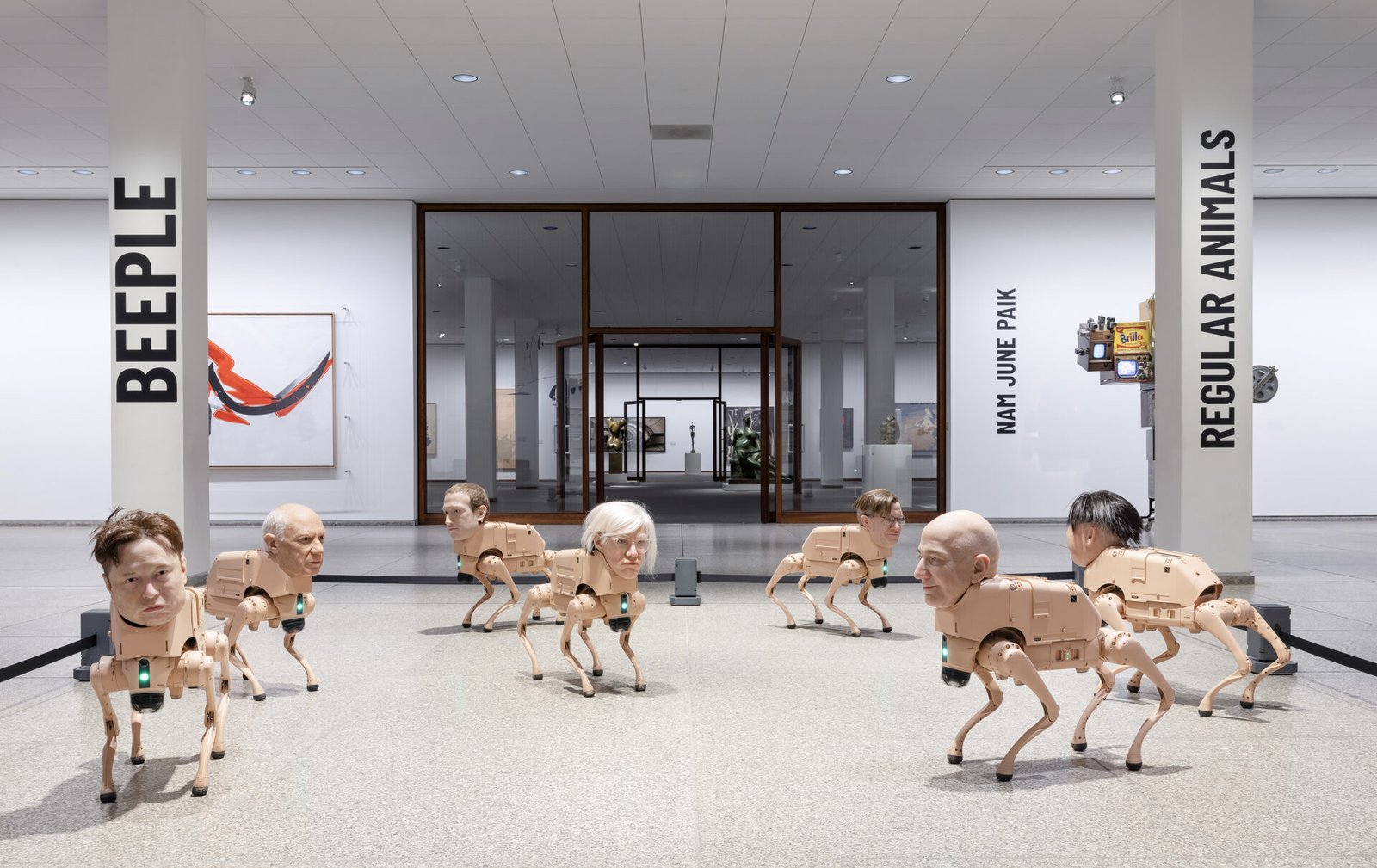
The artist Mike Winkelmann, aka Beeple, has 2 million followers on Instagram. With the sale of an NFT for 69.3 million US dollars at Christie’s in 2021, he broke an auction record and has since become the third most expensive living artist. At Art Basel Miami Beach, his robot dogs, featuring, among others, the heads of Elon Musk and Mark Zuckerberg, caused a stir. Now the robot dogs are on view in Berlin at the Neue Nationalgalerie as part of Gallery Weekend. Beeple is annoying, you hear and read. But why is Beeple so successful?
Over the past few days, you could read and hear all kinds of things about Beeple. In international media, he has been called a crypto star, a tech bro, an outsider, and a controversial artist. His robot dogs have been described as a “dad joke” (Laura Helena Wurth, FAZ) and a one-liner. It has been written that Beeple is annoying, and that surely there are plenty of other good new artworks that could have been shown at the Neue Nationalgalerie during Gallery Weekend instead (Niklas Maak, FAZ). A young art critic replied to my question of whether she would go see Beeple: “Over my dead body.” A professor of media studies sent me a direct message on Instagram asking whether the Beeple show at the Neue Nationalgalerie was actually meant seriously.
And Markus Lüpertz, the 85-year-old Malerfürst (“painter prince”), went on a rant about the robot dogs during his artist talk at the Neue Nationalgalerie. When he goes to a museum, he said, he does not want to be entertained but elevated by art. “When I see these Mickey Mouses running around on the floor here, these dogs downstairs, what does that have to do with a museum? You can do that outside and put a hat next to it and collect money, but in a museum it goes too far. We are not in an event temple here. Art is not an event,” he said.
That art can be an event and a spectacle was most recently demonstrated by Maurizio Cattelan with his banana duct-taped to a wall at Art Basel Miami Beach in 2019. Beeple’s robot dogs were also first roaming around Art Basel Miami Beach before being shown less than six months later in one of Europe’s most important art institutions. They are robot dogs with the heads of Elon Musk, Mark Zuckerberg, Jeff Bezos, Andy Warhol, Pablo Picasso, Kim Jong-un, and, of course, Beeple himself. They move around, take photos, and eventually “poop” out the result. That is, a print comes out the back after the image has been processed and selected by an AI according to certain criteria, such as how interesting it is, based on what it shows: the other robot dogs, the surrounding visitors.


Maurizio Cattelan was also present at the opening of “Regular Animals” in Berlin. Katharina Grosse, the painter star who at some point also made an NFT, was there too, and of course Carolyn Christov-Bakargiev, the former documenta curator, was not missing either. She even sat on the panel at the opening alongside Lisa Botti, the curator of the exhibition, and the artist.
The two curators said that they did not know Beeple or his work before the auction at Christie’s in 2021. What was auctioned was a collage consisting of 5,000 individual images under the title Everydays: The First 5000 Days, which he had previously shared daily on social media over more than a decade. What was new was that it was not simply a huge print, but an NFT, meaning the proof of ownership of a digital file on the blockchain.
Two days later, after Beeple suddenly became the third most expensive living artist following Jeff Koons and Damien Hirst with an auction record of 69.3 million US dollars, Christov-Bakargiev called Christie’s because she wanted to speak to the artist. Since then, she has been regarded as one of the first curators to take Beeple seriously.
In Die Zeit, Jens Balzer diagnosed under the title He’s a dog, that’s for sure (German: Ein Hund ist er schon) that Beeple has fully arrived within the art world and that the art world lies at his feet, because it has to change in order not to lose touch with the present. From where he is now, Beeple, he argues, can look down on the art world.
One could leave it at that diagnosis if the storyline—annoying outsider conquers the art world with a one-liner after an auction record and crypto crash—weren’t itself so annoying and reductive.
If there’s one thing Beeple does not do, it’s look down on the art world. During the opening week, he stood in his exhibition at the Neue Nationalgalerie every single day, all day, answering visitors’ questions about the robot dogs and posing for photos. His father was constantly walking through the crowd of people filming and photographing, handing out flyers so people would at least know what they were filming and sharing on social media.
So why is Mike Winkelmann, aka Beeple, born in Wisconsin in 1981, so successful?
In short: because hot takes don’t just work in art, but also in art criticism in the age of the hyper-reactive human. Because for the first time, a digital artist has managed to create a work that no one can ignore—like Cattelan’s banana, Hirst’s diamond skull, or Banksy’s shredded Girl with Balloon. And because he can do memes, the market, and now the museum.


Hot Takes in Reaction Culture
Back once more to the “painter prince” Markus Lüpertz and his rant. These days, he said on stage at the Neue Nationalgalerie, he no longer wants to call himself an artist when he sees what passes as art today. It irritates him. He sees himself as a painter, as someone who still understands his craft. He wants to bring back mastery. Humility, failure, doubt—he says he doesn’t know them. He presents himself as a master who fell from the sky, because that provokes envy. Of course, he says, painting a picture is a struggle, but he doesn’t talk about that. It would be embarrassing. He also believes that anyone who spends all day in front of a computer playing video games would no longer be able to look at one of his paintings. He himself does not have a mobile phone.
What Lüpertz is describing here is a generational shift in art. Mastery vs. memes, painter prince vs. meme lord. What’s irritating is that he assumes this requires no skill. Mastery no longer lies in the act of painting with a brush on canvas, but in the ability to produce images quickly that circulate immediately because they are understood and can be remixed. And right now, there is probably no one better at that than Beeple.
In conversation, Mike Winkelmann told me that he once assumed people in the art world were especially open-minded. By now, however, he has the impression that many still feel quite comfortable looking at well-made paintings. And if something is particularly popular in other domains—as in his case, graphic design, the art market, and the internet—that can even work against it.
For him, good art has to do with new ideas, with something you haven’t seen before. And because there is now resistance to his work, which is made for the internet, he wants to bring it into the museum even more. He’s not interested in making works that could have been made 60 years ago. That bores him. What interests him is: “How do I make something accessible so people will actually see it? How do I make it cut through the noise of the internet?” And for that, you have to be able to look at it and react immediately. “It has to be fast, fast, and spot on,” he says.
A few hours after Markus Lüpertz’s artist talk, a roundtable organized by the art magazine Spike took place just a few meters down the street at the Julia Stoschek Foundation. The new issue has just been published under the title Everything’s Computer, and the discussion revolved around lore, techno-culture, and the new image regime. The art critic Dean Kissick said: “Technology moves faster than the exhibition schedule.” And that anyone who still believes artists can function as an early warning system for the dangers of technology today must be crazy.
Beeple’s exhibition Regular Animals is the perfect setup for hot takes by the “hyper-reactive human” (Annekathrin Kohout). News and art are no longer simply consumed; they are immediately reacted to on social media. Lüpertz, of course, also banks on his statements provoking reactions. At the height of his career, those reactions took place in newspapers and art magazines. So not that much has changed, except that basically no one can keep up anymore: not the institutions, not the media, not the artists. While I am writing this text about the art scene in Berlin, the art caravan has already moved on to Venice.
With his Everydays, a daily visual commentary on current events shared on social media, Mike Winkelmann has essentially made it his task to keep up. He hasn’t missed a single day in 19 years. That’s also where the skill comes from, the mastery of understanding what a work has to be like outside of social media, as a traditional art object, in order to go as viral as possible. Without a phone, Markus Lüpertz would have a very hard time today as an emerging artist.

Art as Event
With Regular Animals, Mike Winkelmann joins the ranks of artists who have managed to create a work that everyone can have an opinion about—and wants to—without needing any knowledge of art.
Of course, this also involves stating the obvious. Damien Hirst placed diamonds on a human skull, combining mortality and wealth in a single object. What followed was outrage about art as a luxury object. Banksy had his work Girl with Balloon run through a hidden shredder in the frame right after it was auctioned at Sotheby’s in 2018. Well, at least half of it. What followed was outrage about art as a commodity on the art market. Maurizio Cattelan taped a banana to the wall of his gallery’s booth at Art Basel Miami Beach a year later under the title Comedian. What followed was outrage about art in an overheated market.
And Beeple? Mike Winkelmann put the heads of Mark Zuckerberg, Elon Musk, Pablo Picasso, and Andy Warhol, among others, onto robot dogs. What followed was outrage about art as an internet joke. It’s not Beeple who is annoying, it’s the reactions that are annoying. Do we really need to have an opinion on everything? That’s exactly what Zuckerberg & Co. have turned us into: hyper-reactive humans glued to their phones, reacting instantly to everything.
The supposed one-liner or dad joke turns out to be a bit more complex after all. And of course, in various forms, the same question kept coming up: Do we really need this? As the art magazine Monopol, for example, recently asked in relation to Regular Animals: Does a robot dog really need to have Picasso’s head?
In a way, that’s exactly what Beeple wants. “Art is asking questions,” he says. “Here’s the thing, what do you think? It’s trying to be a small mirror or simulation or microcosm of reality, to help you look at the world differently.”
From the Internet to the Museum
Curator Lisa Botti said that the exhibition emerged from an urgent need for museums to seriously engage with debates around technology and AI. Well, yes, but that’s really nothing new in museums. Just as a quick reminder: MoMA regularly shows digital art on its large screen, including works by Refik Anadol, Rafael Rozendaal, and Sasha Stiles. At the KW Institute for Contemporary Art, a show by Holly Herndon and Mat Dryhurst was recently on view. In Düsseldorf, Jon Rafman will soon open at K21. There is the House of Electronic Arts Basel, the ZKM (Center for Art and Media) Karlsruhe, and now even at Art Basel there is a sector for digital art with Zero 10.
And during Gallery Weekend, there were several other exhibitions dealing with the impact of artificial intelligence on society and art: Jonas Lund at Office Impart with an exhibition created by AI agents. Well, humans paint the pictures, but the AI tells them how and what to paint. Mario Klingemann, at SLEEK Art Space, reflects on inert images, images that do not compete for attention, and asks why he, as an artist, should still make images at all. And the DAM Gallery shows, with Vera Molnar, where the history of generative art began in the 1960s.
So what is actually new at the Neue Nationalgalerie? What’s new is that an institution like the Neue Nationalgalerie is showing a digital artist alongside Brancusi and Gerhard Richter, in other words, alongside the greats of art history. That brings a certain legitimacy with it. At the same time, one would have wished for much more contextualization from the institution than simply placing a robot by Nam June Paik next to the robot dogs. With more contextualization, the institution could also have deflected some of the criticism of the exhibition. This is something it could have learned from MoMA, which faced its own backlash a few years ago when it showed Refik Anadol on the large screen in the museum’s foyer. People were calling it a “lava lamp” (Jerry Saltz) or a screensaver.
The cultural and media scholar Paul Feigelfeld from the Mozarteum University in Austria sounded visibly annoyed in a phone call with me. It wasn’t Beeple that bothered him, he said, but the institution, which had turned a museum exhibition into an Instagram spectacle instead of taking seriously the task and role of the museum, which is contextualization.
In Venice, the exhibition Strange Rules, curated by Mat Dryhurst, Holly Herndon, Hans Ulrich Obrist, and Adriana Rispoli, is opening these days. In this context, the term “protocol art” is to be defined, a contemporary subcategory of digital art in the age of AI and blockchain. Other terms such as post-AI, post-medium, and post-artist are currently circulating in the discourse. The art historian Wolfgang Ullrich has just published a widely discussed book, Memocracy: Social Media and Authoritarian Image Politics. There is talk of tech fascism and tech capitalism, and of the role of cyberfeminism in the 21st century.
In short, a lot is happening right now, and there are curators, writers, and academics for whom Beeple was already on the radar before the auction record. It will now be up to future exhibitions to situate Beeple within the history of contemporary and digital art.
[ad_2]
Source link